Red Bull confused or trigger-happy with Verstappen teammates?
F1 NewsWednesday, 09 April 2025 at 13:25
In an exclusive with GRANDPRIX247, we had the opportunity to do a short interview with Professor Richard Hopkins regarding Red Bull’s second driver conundrum and their quest to find a suitable teammate for Max Verstappen.
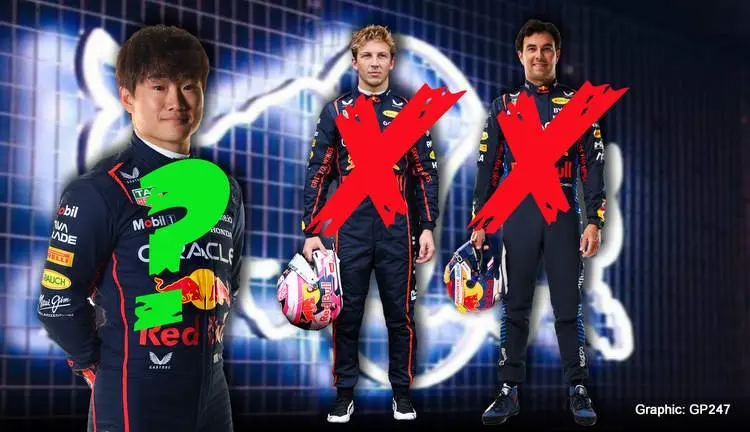
Red Bull used a third different driver in four races to try and solve their number two driver crisis after they sent Sergio Perez packing at the end of last season. Liam Lawson was tested and tried but brutally found lacking after two races. Another Verstappen victim.
The Kiwi was sent back to join Isack Hadjar in the Racing Bulls junior team, with Yuki Tsunoda the next 'lamb to the slaughter' in the lion's den, as four-time F1 World Champion Verstappen raises the bar on a regular basis – as he did so magnificently in Japan this past weekend - it gives that seat 'Poisoned Chalice' status according to best Netflix deals of 2025.
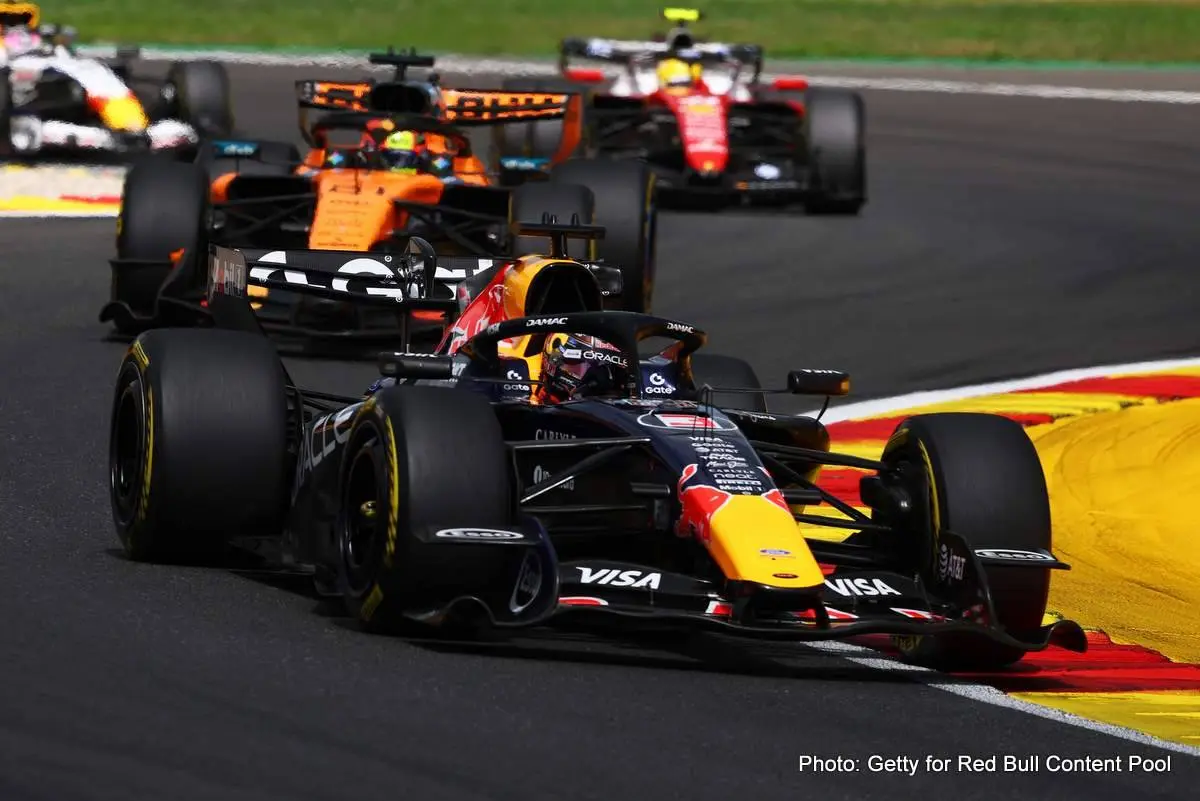
Tsunoda gave it a good shot in free practice and looked to be on top of the finicky, hard-to-drive Red Bull RB21 – until it mattered. He was underwhelming in qualifying. Stats show that Verstappen's pole-winning time was a full second faster than Yuki's best effort.
Max crossed the line to win the Japanese Grand Prix on Sunday, followed by new teammate Tsunoda 58 seconds later in P12. Notably, rookie Hadjar finished P8 thanks to a gutsy performance that is becoming his trademark in the wake of the Melbourne DNS gaffe. Lawson was P17 in his return race with Racing Bulls.
Departing Japan, no one is convinced that the Red Bull second driver saga is sorted by any means. Is Tsunoda the solution? If not, what next? Step up Professor Richard Hopkins to share his thoughts on a team he knows well. [See his bio at the foot of this post.]
Just over a decade ago, Hopkins was a part of Red Bull's domination of the sport – the team’s golden era led by Sebastian Vettel – at which time the professor was Head of Operations with the team.
Hopkins: Helmut's no idiot and Christian's no idiot

In an interview made possible by the media team at Prime Casino, this is what Hopkins had to say on the 'finding-a-teammate-for-Verstappen-conundrum' at his former team. He began by acknowledging: “They’ve found themselves in a scenario that I don't think either Christian Horner or Helmut Marko are particularly happy with. It’s highlighted, perhaps, a flaw in their development programme.
"On paper, the system works well: you bring a young hopeful into the sister team, let them mature, and then they’re elevated into the main team. But I think they've been a little bit trigger-happy. Look at the history — whether it’s Carlos Sainz, Daniil Kvyat, Pierre Gasly... the list goes on.
“Red Bull are now in a position where they want two number-one drivers — two equally matched drivers. At the end of the day, teams are more than happy for a driver to win the World Championship, but what they really want is to win the Constructors’ Championship. That’s where the bragging rights are.”
Referencing how McLaren beat Red Bull to the 2024 Formula 1 Constructors’ title, Hopkins said: “You’ve got Christian, and you’ve got Zak Brown. Zak won the Constructors’ last year; Christian didn’t — and that was because he didn’t have two performing drivers. Zak did. He had two drivers who could consistently bring in good points, race after race.
“That’s what won the Constructors’ Championship. So Red Bull are now in that position: where do they go to get that second driver? It’s a case of damned if they do, damned if they don’t. If they roll the dice and go with Liam Lawson... they’re not idiots. Helmut's no idiot. Christian's no idiot.”
Why was Lawson axed so quickly? How long for Tsunoda?

Of the merciless axing of Lawson after only two races with Red Bull, Hopkins ventured: “They’ve made calculated decisions, believing they were sound. It didn’t work out in the first two races — Liam seemed to struggle. How long do you give a driver the opportunity to prove themselves?
"This is the very top level, and Liam, for one reason or another — maybe the wet race in Australia, whatever — didn’t get up to speed as quickly as he should have. Would I have left it longer? Probably not, based on the fact that I know I lost the Constructors’ Championship last year because I didn’t have two strong drivers. I don’t want to fall into that position again.
“Liam's already cost Red Bull around 20 points this year. That’s probably a bit cruel, but he’s lost them a handful of points. So what do you do then? Because you’re running this academy, you’re almost bound to look at your sister team.
“So then it’s Isack Hadjar or Yuki Tsunoda. And suddenly you’re thinking, ‘Shit, maybe we should’ve gone with Yuki over Liam in the first place.’ So yeah, they’re kind of damned if they do, damned if they don’t. It should be a system that produces positive outcomes.”
The real problem is not the second Red Bull driver, it's the fact that Verstappen just gets better and better while destroying his hapless teammates time and time again. Like most serious Formula 1 fans, ex-drivers and pundits alike, Hopkins struggles to find superlatives: “The guy is clearly gifted and operating at an extraordinary alien-like level. But that’s also down to the circumstances.
"If you put Max in a McLaren tomorrow and swapped him for Oscar or Lando, I think you'd find Max would only be a tenth, maybe half a tenth, quicker than them. But the scenario Max is in — driving a car that may be a little challenging — is bringing out the very best in him."
Watch live F1 with streaming bundle deals.
Who do you put next to Formula 1 benchmark Max?

Hopkins cites Verstappen's gargantuan 2025 Japanese Grand Prix pole-winning lap in Qualifying on Saturday: “That lap at Suzuka to snatch pole position for the , just 0.012s ahead of Norris and a couple more hundredths on Piastri...
“I didn’t see it coming. No one did. I’m sure there are bookmakers around the world who’ve lost millions as a result. Max is the benchmark. We’re judging everyone against him, and he's performing at what seems like a supernatural level.
“For Max, operating at 100% is normal. That’s his baseline. I think if we could quantify his performance on a scale of 1 to 100, in Japan we saw him at a true 100% all weekend. In past title years, when the car behaved better underneath him, maybe he was only operating at 92% — but even then, others were at 90%, so he was still ahead.”
Regarding who will replace Verstappen when he eventually departs Red Bull, Hopkins said of the options: “I think Toto pulled an absolute masterstroke with Kimi Antonelli. If I were Toto, I wouldn’t budge.
“Maybe Zak Brown and Mr Mark Webber have a say. Mark might look at the situation and ask: is there more chance of Piastri winning a championship at McLaren, based on what we know today, than at Red Bull?
“Right now, Red Bull seem to be on a downward trajectory. They’ve lost Rob Marshall — and that shouldn’t be underestimated. Losing Adrian [Newey] is one thing, but losing Rob too? It’s no coincidence that Red Bull have started to lose their way a bit, just as McLaren have started to find theirs."
Driver solution should Max follow the billion dollars and bail out of RBR? “Tough call,” concluded Prof Hopkins.
Who is Professor Richard Hopkins?

Richard Hopkins, former Head of Operations at Red Bull Racing during their four consecutive Formula 1 World Championship wins, says his mission was clear when he joined the team in 2007: “Make us into a team of winners.”
Speaking of his early career, Hopkins recalled entering Formula 1 at just 16 after landing a role at Brabham under Bernie Ecclestone. He remained with the team until 1991 before moving to McLaren, where he began travelling the Grand Prix circuit as a mechanic and worked with legends including Ayrton Senna, Alain Prost, Nigel Mansell, Mika Hakkinen, Fernando Alonso, Kimi Räikkönen and Lewis Hamilton.
In the early 2000s, Hopkins took on a more operational role at McLaren, delivering business efficiencies that translated to improved on-track performance. Red Bull came calling in 2007, with just two third-place trophies in their cabinet.
By the end of 2015, Hopkins had played a key part in 509 Grands Prix over 28 seasons, contributing to Red Bull’s first 50 wins and helping fill a now sizeable trophy cabinet with 169 podium finishes.
Now based in Sydney, he is a Professor of Practice at UNSW and runs a high-performance coaching business, focused on cultural and environmental transformation.
Latest News




Loading