Reader Rights: With tyres you may be wrong, you may be right
F1 NewsSaturday, 29 August 2015 at 12:37
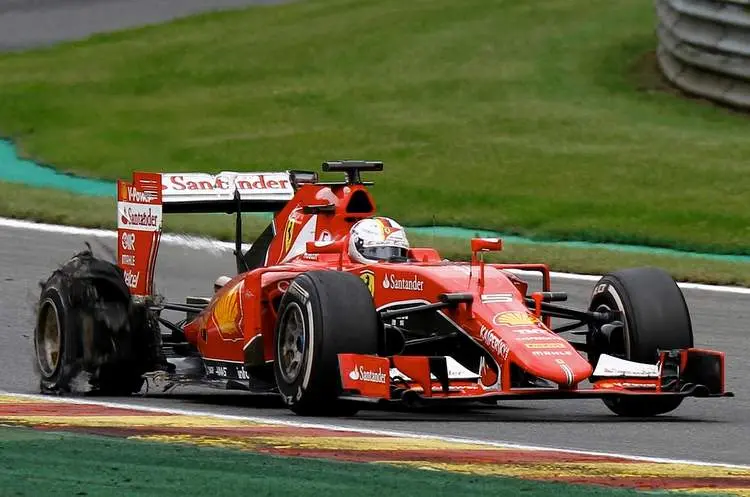
An Formula 1 driver should never be in a position in the course of racing that he has to gamble with the integrity of a tire.
I've seen people make quips online about Bridgestone and Michelin tires blowing out during the Tire War. That this is somehow no different, and that it's even to be expected. The problem with referencing that era is that it was a completely different design dynamic than what we have now.
During the Tire War there were two companies making bespoke tires for teams. In this case, both companies were pushing themselves to their respective design limits. One design limit was the performance window, another maybe weight. One limit was inherent - the tire must maintain integrity.
During the Tire War, the respective companies had to make a choice in managing the risk of a tire blowing out, versus running it to the edge of it's performance, or it's "useable lifespan".
Michelin hit the limit between performance degradation and integrity. They had to defer to safety, and reign the use of their tires in. Their decision making was predicated on acknowledging the distance between the working envelope of their tire.

Pirelli's corporate decision making process is considerably different. They are still operating under the same parameters, with a margin from the performance envelope to the limit of safety. They have an exceedingly trickier task, in that for them there is a construction landmark halfway between.
That landmark is labeled "built in performance degradation". Which, given the multitude of possibly variables involved, can only be a suggestion, a guesstimate. Their task is to deliberately design in early fall off, and to manage how radically that occurs.
When in history has a global company been asked to make their product intentionally not as good as it could be? A similarly unique task.
Pirelli's suggestion of the performance window Vettel was operating under at Spa to be implied by the parameter of 30% of a race distance being the limiting factor. In this case 22 laps, versus Vettel's 28.
The question is then raised, does that mean the competitive performance of the tire is designed to not go beyond 22 laps, or is there a safety aspect involved?

The onus is on them to firmly state when a tire cannot be guaranteed to be safe. Giving the teams a somewhat intangible approximation, particularly given the extreme nature of Formula One, would seem to be a bureaucratic solution to covering their fortune.
It avoids the possible bad light of having to say the tire is definitely not safe after 30%, while at the same time giving them the proverbial legalese excuse for such an event as what took place at Spa.
While Pirelli's task is difficult, the problem is twofold in their own culpability. They both agreed to the tricky business of designing a tire to degrade, as well as choosing to be vague with their safety limit.
In leaving interpretation of this margin up to an outside party, the teams or the drivers, it's perhaps legally not Pirelli's fault. Hembery is right, Vettel exceeded the 30% "suggestion". At the same time it was not a case of Ferrari knowingly risking Vettel's life by going over a specified safety limit.
Vettel is right, in that a driver should never be allowed into a situation where the tire could potentially explode. If this is a possibility at the 30% number, then it's not a suggestion, it's the limit itself. Pirelli should make it clear: do not drive on the tire beyond this limit.

It should not be up to the adventurously skilled driver to explore where the tire integrity limit is beyond the performance limit! Those are two different issues.
The real story, in my opinion, is that probably in a lot of cases the choices Pirelli are being forced to make hide the distance between when a tire's degradation becomes theoretically non-competitive, and the point in which it can potentially fail being a tire.
At Spa this was apparently approximately 6 laps. I would point out that it can only be approximation by default, and Pirelli should take the responsibility of not hiding behind that approximation.
There should be a very strict pronouncement of how many laps is the safety limit. That is for Pirelli as a company to demarcate, and while challenging a task it may be, it's one they have taken upon themselves.
Personally I hate the two compound rule, and the very notion of deliberately designing tires to be less than optimal, but I am not the FIA. Having said that, the FIA should demand Pirelli make it very clear, from Monza on, exactly how many laps can be run on the tires before there is a risk of failure. The FIA should then make it a rule that you can't drive beyond that limit.
The idea that Pirelli suggests what the potential performance lifespan is of the tire is itself inherently ridiculous, because it defeats the premise that auto-degrading tires throw some aspect of randomness into the equation, while at the same time asking a driver to attempt to drive beyond this point by "managing the tires".
Vettel is right, Pirelli is right. A situation caused by the ridiculous two compound rule, and the knock-on effect in that the tire manufacturer has the onerous task of embracing the dichotomy of simultaneously making what is effective a defective tire that is also supposed to be safe.
Another argument for a return to free testing, to let the teams choose between three set compounds established before the season begins - hard, soft, medium. Then get on with racing, not these continual engineering detours we've been subjected to this year!
Opinion by GrandPrix247 Reader Chip McDonald
Latest News




Loading