As 2025 comes to a close, now feels like the perfect time to cast an eye over the youngsters vying to break into Formula 1, assess their chances, and tee up an exciting season ahead.
With recent graduates like Kimi Antonelli, Isack Hadjar, and Ollie Bearman, Formula 2 is the obvious place to look. F2 has a reputation for action-packed, super-chaotic races, and last season was no different. Irishman Alex Dunne competed with relative veteran Richard Verschoor for much of the early championship but later slipped out of contention.
In the end, it was F3 champion Leo Fornaroli who held off a late fightback from Jak Crawford to take back-to-back junior crowns. But in the lower ranks, it’s not always about results—it’s more about showing your potential, gaining backing, and plenty more besides.
Heading into 2026, a fresh batch of talented drivers are set to be given the opportunity to show what they’re capable of. Let’s take a look at some of the ones to watch next year.
Who is being retained in Formula 2?

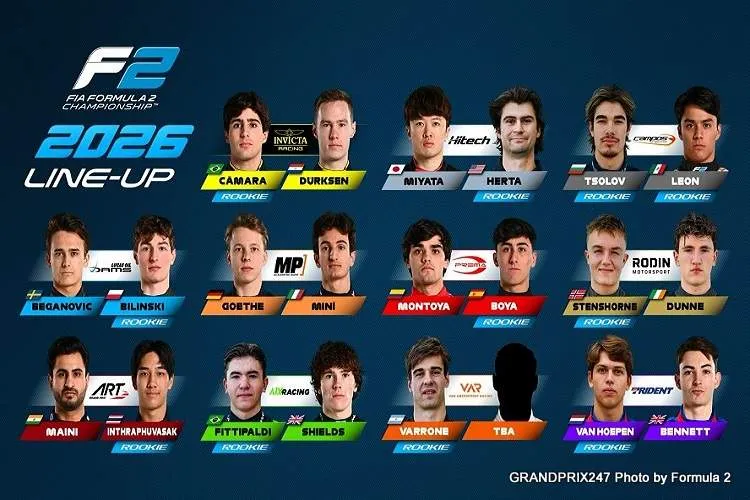
Before getting into the newcomers, let’s take a look at who’s staying in F2. The headline news is that Dunne will be back next year. Despite splitting with the McLaren academy last season, he’ll be competing with Rodin again in 2026, giving him another crack at the title.
Ferrari junior Dino Beganovic is also staying put, and deservedly so! The Swedish-Bosnian had his moments in 2025, impressively winning the Sprint in Baku.
Ollie Goethe missed out on the vacancy at Red Bull created by Yuki Tsunoda’s departure, but he too will return next year. Similarly, Goethe showed flashes of brilliance, climbing from 15th to fifth in the Sakhir Sprint Race.
With greater consistency, he could be one to watch. Cian Shields and Kush Maini—two more drivers needing time to show their full potential—will also be back.
Although Maini won the Monaco Sprint, he suffered a challenging second half of the season. He’ll be hoping that switching from DAMS Lucas Oil to ART will offer better opportunities next year.
Newcomers shake up next year's field

Colton Herta is undoubtedly F2’s headline addition for next year. Three years ago, the American was denied a super license, despite reported interest from Red Bull. Now he’s trying to keep his single-seater dream alive by winning enough license points in F2.
It’s an incredibly bold move. He’ll likely need a top-eight finish to earn the points needed for an F1 entry. As Cadillac’s reserve driver, he’s already got the next step lined up, so it’ll be fascinating to see if he can transfer his IndyCar skills to a very different racing discipline.
Martinius Stenshorne and Nikola Tsolov were handed their F2 debuts late last year. Now Rodin and Campos have offered them full-time seats. Interestingly, Emmerson Fittipaldi Jr., son of the 1972 & 1974 F1 world champion, has also been confirmed by AIX Racing. Will he pull a Nico Rosberg and replicate his father’s feat? Or will he be a Bruno Senna? It’ll be exciting to watch.
As Sebastian Montoya has shown at Prema, replicating your father's success is definitely not a given! Further down the junior pecking order, Tasanapol Inthraphuvasak, Rafael Camara, Roman Bilinski, Laurens van Hoepen, and Noel Leon have all been rewarded with F2 drives for strong Formula 3 campaigns. Endurance star Nicolas Varrone completes the rookie field.
Is anyone stepping up to Formula 1 in 2026?

Amid sweeping rule changes, many F1 teams have prioritized experience for next season. As such, only Arvid Lindblad is graduating directly to the big league. He’s replacing Hadjar at Racing Bulls, another F2 success story who has been promoted to Red Bull’s senior team.
That said, he won’t be the only graduate in the paddock. Crawford has also been given a reserve drive by Aston Martin, while Verschoor and Fornaroli have been signed up to McLaren’s driver development program. No doubt, these drivers will have coveted a full race seat. But the likes of Oscar Piastri have shown that patience can be a virtue in these situations.
Next year, F1 teams will continue to field rookies in at least four practice sessions. So we can expect to see these promising reserves, as well as drivers competing in the junior categories, get their chance behind the wheel. The road to F1 can be a treacherous one, but it’s clear that the future is in safe hands—and next season, the feeder series could well be worth a watch!
loading
Latest News
Loading