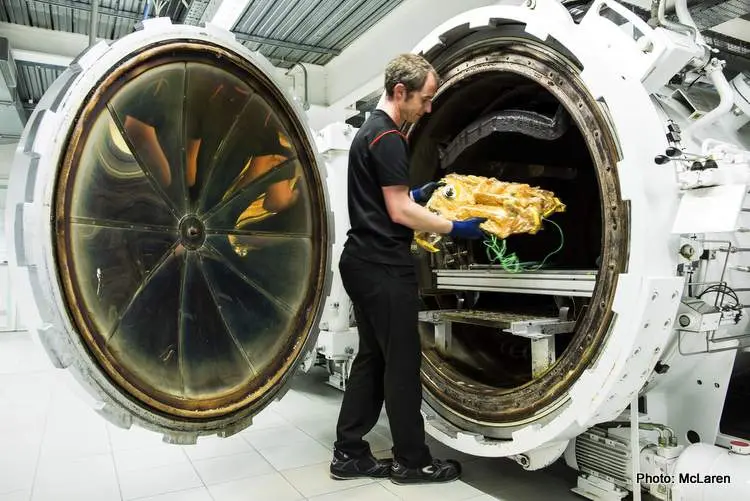
McLaren's Operations Director Piers Thynne admits the workload for the team's production department has increased by 20% with the new car, as Formula 1 teams now race against time to finish their 2022 F1 cars in time for the first pre-season test.
The first pre-season test is scheduled for February 23 and will run for three days, and McLaren has already shifted into high gear as they race to complete their 2022 F1 car, the MCL36 ahead of its announced reveal date on February 11.
With the new cars being built around new aero regulations and 18" tyres, with the restraints of a reduced cost cap, producing a new car is proving to be a challenging albeit exciting endeavor as Piers Thynne - Operations Director at McLaren - explains in an interview on the team's website.
January and February are usually a hectic time for an F1 team's production team, and according to Thynne, this year is no different.
"January and February are super busy – but you really see people at their best when they’re working to a fixed deadline, under pressure to perform," he said.
"What we see across the MTC is fantastic teamwork, good communication and good collaboration. That unlocks the complexity of the task that we’re working through, which is to deliver a wholly new car to a wholly new set of regulations."
McLaren's production workload increase by 20%
Thynne's division at McLaren are handling extra work load this winter, he said: "I think the numbers tell a story.
"The bill of materials is similar to what we have in any other year (same total number of parts, same amount of tooling), but this year, when compared to those previous years, we’re running hotter, with a little over 20% more work in progress across the factory and our supply chain."
The team has to work without the luxury of having carryover car parts from last year, due to the radically new F1 cars in 2022.
"The product is of similar complexity but all of it is new: there are very, very few bits of carryover," McLaren's production man said. "Most years we would be using – or at least modifying – parts from the previous car, but that’s not the case with the MCL36.
"It’s all new – and obviously, that puts significant pressure on our resources, and strain on our supply chain as well – we’re feeling a little indigestion in some of our key projects!"
When asked if the new car is more difficult to produce, Thynne said: "They’re all tough! It’s tricky to compare them – because they’re never directly comparable.
"We look at the burden of work versus a similar week in previous builds, and that’s how we know we’re doing 20% more work this year – but comparing them may be a bit subjective and perhaps not really the right way of looking at it.
"Building the MCL36 to the new regulations is a significant burden, but it is perhaps more the cultural change of doing some things in a different way," he mused.
"We are very keen to be as late as possible and as lean on stock as we can be, to ensure there is opportunity to deliver upgrades in sync for race one. The layout of the programme is fundamentally different for the ’36 compared to previous cars.
"The programme is difficult, and when you factor in the constraint of the cost cap on top of a significant engineering and manufacturing challenge, that’s when you really have to rely on great teamwork, great collaboration and a total laser focus on achieving targets.
"Ultimately, it’s the quality of our people we rely on when it gets tough, and we’re lucky because our people are second to none," the engineer insisted.
If you’re not encountering issues, you're not being aggressive
When asked about his belief that issues are a product of an aggressive approach, Thynne responded: "That’s still true! If it’s all going smoothly, you’re not trying hard enough!
"You’ve not given as much time as you can to the engineering department and haven’t allowed them to squeeze every ounce of performance out of the design.
Moving on to the cost cap subject, the Operations Director explained that many changes have been applied in the work culture as well as the processes and intra-team communications.
"It’s a multifaceted challenge that we’ve been working on for many, many months. You must tune the levers which will deliver an outcome," he began.
"Some of that is ensuring operationally and technically we understand what things cost. We now have a live costing tool for many parts that allows everybody to understand cost much better. Again, collaboration is key, in this case using experience from across the team to evaluate parts at the concept stage, while they’re still in design, to make sure we’re owning the manufacturability of a part.
"Making sure known issues have been corrected; making sure when we’re using expensive raw materials or difficult and time-consuming processes, it really does need to be done in that way and we can honestly justify it.
"We’re having those positive conversations upstream, during the design phase, rather than when we receive the part in manufacturing," Thynne revealed. "It’s helped us gain back some run time on our machine tools, because sometimes the engineers have been able to say: ‘it doesn’t have to be done that way: if I can change it, would that be better from a manufacturing perspective?’ This is new territory for us.
"There’s a long journey ahead but we already have several success stories, and the drive to collaborate, and make sure our parts are as easy to manufacture as they can be without compromising performance, is already entrenched."
Less spare parts, more upgrades
Something that should be on the back of the drivers' minds these days are spare parts, which won't be as abundant as before to allow for more upgrades with the cost cap in place.
Drivers won't have the luxury of breaking their cars with the assurance that the team has the necessary parts to fix them, which means less flirting with the limits and less recklessness
"The other lever we can pull is making production as lean is it can be," Thynne pointed out in this regards. "We’re manufacturing fewer [spare] parts. That, again, is a cultural shift, but it will allow greater flexibility to consider upgrades. It’s a difficult trade to make but we will have smaller quantities of parts available for the ’36 than we had for the ’35M, to have room in the budget to deliver more performance.
"We’re not going to ever have too few parts to run the cars, we’ll always protect that, but where in the past we would have made five or six parts, we’re dropping to five; where it was four or five, we’re dropping to four," he went on.
"Where there are multiple set-up options of a part to fit, we’re considering rationing how those choices are made, collaborating with the race engineers to make sure we’re providing the choices they will want to use, rather than the choices they might want to use – because every pound counts and we’ve got to make sure we’re spending wisely."
Race one performance critical
Speaking of the rate of development of the new cars, Thynne said: "We know performance at race one is critical, and we’ll be delivering an upgrade package to that event – but we expect much more to follow.
"One of the reasons we’re being lean on stock is that we know we want to evolve the car. There are no prizes for having six floors and six front wings at the first race.
"We’ll be taking some subtly different approaches this year to make sure production capacity is available and can respond to aerodynamic evolution.
"That will be key to success this year," the engineer who has been at McLaren since 2008 insisted.
McLaren finished last season fourth in the Constructors' Standings behind Ferrari despite winning their 1-2 at the 2021 Italian GP. They will contest the 2022 F1 season with the unchanged driver lineup of Daniel Ricciardo and Lando Norris.
Latest News


Loading