Facts, Stats and Technical Preview of the Japanese Grand Prix weekend, Round 17 of the 2018 Formula 1 World Championship, at Suzuka.
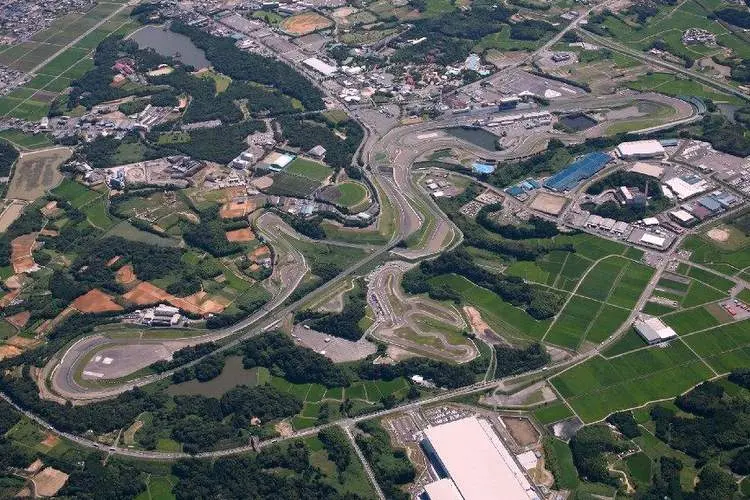
The layout of Suzuka is a figure-eight, and it is the only track in Formula One with such a configuration. A bridge crossing over the straight that links turns nine (Degner 2) and 10 is a signature of the challengung venue, with drivers nearing 330 kph (205 mph) as they go across the bridge through turn 15, better known as 130R, so named because of its 130-meter radius.
The first sector of the track caters to a car’s aerodynamic efficiency, while the second sector rewards horsepower. The entire course features every kind of corner, and its relatively old asphalt surface provides a high level of grip, which combined with high lateral loads through the corners accelerates tire wear.
As such, Pirelli has brought its White medium, Yellow soft and Red supersoft compounds to Japan as the island nation becomes acceleration nation.
Reuters Statistics for the 2018 Japanese Formula One Grand Prix in Suzuka:
- Lap distance: 5.807 km. Total distance: 307.471 km (53 laps)
- 2017 pole: Lewis Hamilton (Britain) Mercedes one minute 27.319 seconds.
- 2017 winner: Hamilton
- Race lap record: Kimi Raikkonen (Finland) McLaren 1:31.540 (2005)
- Start time: 1410 local (0510 GMT)
Japanese Grand Prix
- Hamilton and Vettel have both won four times in Japan.
- Mercedes have won the last four Japanese Grands Prix.
- Ferrari have not won at Suzuka since Michael Schumacher’s last Japanese success in 2004. Schumacher won the Japanese Grand Prix a record six times.
- Fernando Alonso (2006 and 2008) and Raikkonen (2005) are also past winners in Japan.
- In 29 races at Suzuka, the winner has come from the front row on 25 occasions and been on pole in 14. Raikkonen is the standout exception, winning from 17th on the grid in 2005.
- Seven of the last 13 winners have started on pole.
- There have been 33 Japanese Grands Prix since 1976, four of them at Fuji. There is no home driver at present but Honda own the Suzuka circuit and power Toro Rosso.
Race Victories
- Hamilton has eight wins this season to Vettel’s five. Daniel Ricciardo has two and Max Verstappen one.
- Hamilton has 70 victories from 224 races and is second in the all-time list behind seven-times world champion Michael Schumacher (91). Vettel, third on the all-time list, has 52.
- Ferrari’s Kimi Raikkonen has now gone 110 races since his 20th and last win, in Australia in 2013.
- Ferrari have won 234 races since 1950, McLaren 182, Williams 114, Mercedes 84 and Red Bull 58. Former champions McLaren and Williams have not won since 2012.
Pole Position
- Hamilton has a record 79 career poles, Vettel 55.
- Verstappen, who turned 21 in Russia last Sunday, can still become the youngest ever pole sitter. The current youngest is Vettel, who did it at 21 years and 72 days.
Podium
- Hamilton has 130 career podiums and is second on the all-time list behind Schumacher (155). Vettel has 109, Raikkonen 100.
- Mercedes’ Valtteri Bottas has had six second-place finishes this season.
Championship Points
- Hamilton leads Vettel by 50 points with five races left, meaning he can take his fifth title without having to win again.
- Mercedes are 53 points ahead of Ferrari in the constructors’ championship and also on course to wrap up the title before the final round.
- Every driver on the starting grid has scored this season.
Milestone
- Hamilton can take his 80th pole on Saturday.
- The Russian Grand Prix was Raikkonen’s 200th points finish. Only Schumacher and Alonso have more.
Suzuka - venue of the Japanese Grand Prix - has perhaps become the most challenging circuit on the F1 calendar in recent years, owing to the fact that many of the corners on layouts such as Silverstone and Spa have become flat-out, whereas those at Suzuka, especially in Sector One, have become more difficult for the drivers.

Another aspect which sets Suzuka apart from many other circuits is that there is much less in the way of run-off areas than at other tracks.
Downforce vs Drag
- As at the most venues, downforce must be compromised for lower drag, but the extreme nature of the circuit makes this particularly difficult.
- Straight-line speed is of reasonable importance to laptime, as well as to potential overtaking opportunities, but the part of the lap up until T11 lends itself to very high Aerodynamic downforce, such is the density of corners up until this point.
- Most teams will test at least two wing set-ups in order to gain track data that can be fed into the final decision making process – it should be expected that there will be converge on a medium downforce set-up, which means spoon rear wings for Mercedes and Ferrari.

Car Strengths Needed
- All attributes of a car must be strong in order to result in a competitive lap time in Suzuka, but the emphasis is on Aerodynamic efficiency, high-speed downforce and good change of direction.
- In addition, Suzuka is a power track, with significant full throttle sections running into Turns 1, 13 and 16, which should favour those with Ferrari and Mercedes power units.
Key Corners
- Turn 7 – the Dunlop Curve was almost flat-out in qualifying on Hamilton’s 2017 pole lap, so should not require lifting for the top teams, which will accentuate the gap between them and the midfield.
- Turn 11 – front locking is common into this hairpin, something not helped by the right hand kink on entry.
- Turns 13/14 – the Spoon Curves are almost impossible to perfect, with understeer a persistent problem, especially in Turn 14; getting on the power as soon as possible will maximise speed along the ensuing full throttle section, to T16.
Tyres

- Pirelli is bringing the same tyre compounds names as it did in 2017, but they are all a step softer than last year.
- Last year’s race was a straightforward one-stop using tyres which are equivalent to this year’s Soft and Medium, with these two compounds capable of 25 and 40 laps respectively.
- Therefore, a one-stop should be possible using the harder two compounds, with Mercedes’ tyre allocation suggesting it has this strategy in mind – this will require setting its fastest Q2 lap time on the Soft. McLaren has been extremely conservative in its selection, deciding to select very few sets of the SuperSofts, which will mainly be set aside for qualifying, suggesting it will focus greatly on race preparation with the harder two compounds in practice.
- However, Ferrari and Red Bull will not use the Medium tyre for running in practice, and are therefore unlikely to do so in the race either, suggesting they will have to make a SuperSoft-Soft combination work, which is particularly aggressive.
- The tyre life of the SuperSoft will be critical in determining the performance of those qualifying behind the top three teams, but who are in Q3, since they will most likely have to start on this compound. It must last long enough for these cars to create enough of a gap to pit and emerge ahead of those at the rear of the field, starting on the harder compounds, to avoid being held up after their stops.

Overtaking/DRS
- Although Suzuka is a difficult track on which to overtake, thanks to the multiple high speed corners in Sector One making following another car challenging and the presence of only one DRS zone, it works well due to the fact that the run from Spoon to the final chicane allows a following driver to slipstream closer to the car ahead, before using the DRS zone along the main straight to set up an overtake.
Weather
- Early forecasts suggest rain is a possibility on all 3 days, but that the probability will decrease through the weekend.
- This will potentially cause headaches for teams, as they may lack some of the normal data they accumulate on a Friday to approach set-ups work for the remainder of the weekend.
- Temperatures for race day look set to approach 30 degrees celsius, which will make tyre life even more critical, and perhaps favour Mercedes given what their tyre allocation suggests about strategy heading into the weekend.
Form Guide
- Silverstone is a very good barometer for performance in Suzuka given the similarity in terms of track layout and average speed, but the key difference to that time of year is that Mercedes have made a significant performance step in recent races, whereas at the time of the British GP, Ferrari seemed to be on top in general.
- In the midfield, Force India and Haas will likely dominate, while Renault will be looking to improve after losing points in Russia in the battle for fourth in the championship.
loading
Latest News



Loading