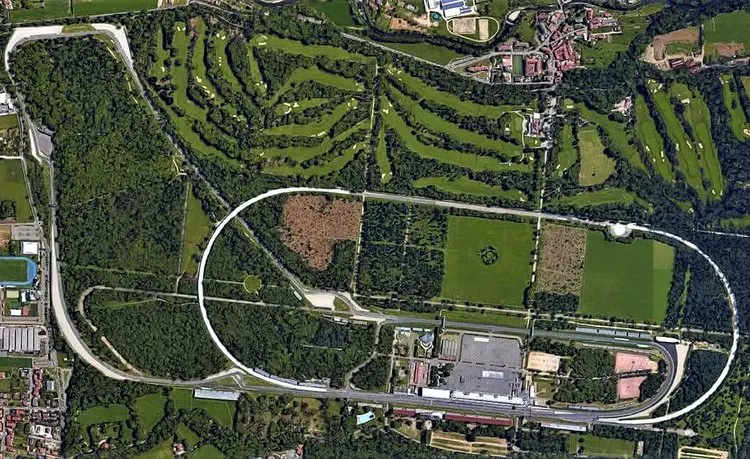
Monza has hosted Formula 1 since 1950, with this year’s Italian Grand Prix serving as the venue’s 68th grand prix, Round 13 of the 2018 Formula 1 World Championship.
The average winning speed in the first Italian Grand Prix was 176.55 kph (109.7 mph). Last year’s was 243.627 kph (151.383 mph). As Formula One technology has advanced, its display of speed has been most impressive at Monza, where the track has earned the moniker, Temple of Speed.
Despite today’s Formula 1 cars being outfitted with turbocharged 1.6-liter V6 engines, engineers have wrung considerable power from these tightly packaged units. And thanks to an aerodynamic and tire package introduced last year that has increased downforce and corner speeds, lap times have dropped substantially.
Case in point: the fastest lap in last year’s Italian Grand Prix – a 1:23.361 at 250.174 kph (155.451 mph) set by Red Bull’s Daniel Ricciardo – was more than two seconds better than the fastest lap from the 2016 Italian Grand Prix.
The rub, however, is that these current-generation Formula 1 cars are not as fast in a straight line, as their increased downforce creates increased drag. It’s in the corners where these cars shine.
Monza has 11 turns, which means that despite its long straights, there is speed to be found. Can Montoya’s 14-year-old mark survive this inevitable evolution of Formula 1? Time will literally tell.
The Essentials
- Focus points Straight-line speed. More than 75 per cent of the lap is spent on full throttle - the highest percentage of the season – and the cars exceed 300km/h (186mph) on four occasions around the lap. Hence Monza is known colloquially as the Temple of Speed.
- Unique difficulty The pit-lane. Traditionally, there are more speeding offences in the Monza pit-lane than at any other racetrack. The reason given by the drivers is the speed differential between the 80km/h (50mph) pitlane and the 350km/h (217mph) start-finish straight makes it difficult for them to judge their braking point for the pit-lane entrance.
- Biggest challenge Braking. There are only six braking zones on the lap, but each of them is severe, which makes Monza one of the hardest of the season on brakes. The average deceleration is 5.5g, with the hardest braking zone being Turn One, where the cars slow from 350km/h (217mph) to 70km/h (43mph) in just 2.8s.
Engineer's Lowdown
- Braking Heavy. This is a tough race for brakes, with an average of 9.7s per lap spent braking and an average deceleration of 5.5g per corner.
- Power The cars use 1.8kg of fuel per lap, which is average, but this is a tough race for ERS because there are only six braking events at which to harvest energy.
- Aero Low downforce. In 2016, the most recent dry qualifying session, pole position was set at an average speed of 257km/h (159mph). That makes Monza the fastest lap of the season and, as a consequence, the lowest downforce track. With less aerodynamic grip, the cars are more skittish to drive than normal, particularly under braking.
Statistics for Sunday’s Italian Formula 1 Grand Prix at Monza:
- Lap distance: 5.793 km. Total distance: 306.720 km (53 laps)
- 2017 pole: Lewis Hamilton (Britain) Mercedes one minute 35.554 seconds.
- 2017 winner: Hamilton
- Race lap record: Rubens Barrichello (Brazil), Ferrari. One minute 21.046 seconds (2004).
- Start time: 1310 GMT (1510 local)
Italian Grand Prix
- Hamilton has won at Monza four times in the past six years and can equal Michael Schumacher’s record of five.
- The Briton has been on pole for the past four years at ‘La Pista Magica’ and five of the last six.
- A win by Ferrari’s Sebastian Vettel on Sunday would make him only the second driver, and first since Britain’s Stirling Moss in the 1950s, to win at Monza with three different teams. Moss won with Maserati, Vanwall and Cooper.
- Vettel has done so previously with Toro Rosso (2008) and Red Bull (2011 and 2013).
- The Italian and British Grands Prix are the only ones to have featured every year since the championship started in 1950.
- The Italian race has been staged at Monza every year except 1980 when it was at Imola.
- The race has been won from pole position 10 times in the last 13 years, and 14 of the last 19.
- Ferrari have won 18 times at Monza, more than anyone else.
Race Victories
- Hamilton and Vettel both have five wins this season. Red Bull’s Daniel Ricciardo has two and Max Verstappen one.
- Hamilton has 67 victories from 221 races and is second in the all-time list behind seven-times world champion Schumacher (91). Vettel, now third on the all-time list, has 52, Ricciardo seven.
- Ferrari’s Kimi Raikkonen has now gone 107 races since his last win, in Australia in 2013.
- Ferrari have won 234 races since 1950, McLaren 182, Williams 114, Mercedes 81 and Red Bull 58. Former champions McLaren and Williams have not won since 2012.
Pole Position
- Hamilton has a record 78 career poles, Vettel 55.
- Verstappen, at 20-years-old, can still become the youngest ever pole sitter this season. The current youngest is Vettel, who did it aged 21 years and 72 days.
- Verstappen’s birthday is on 30 September
Podium
- Hamilton has 127 career podiums and is second on the all-time list behind Schumacher (155). Vettel has 107, Raikkonen 99.
- Mercedes’ Valtteri Bottas has had five second-place finishes in 13 races.
- Retirement in Spa ended Raikkonen’s run of five successive podium places.
Championship Points
- Hamilton leads Vettel by 17 points.
- Mercedes are 15 points ahead of Ferrari in the constructors’ championship.
- Russian rookie Sergey Sirotkin (Williams) is the only driver yet to score a point this season.
Milestones
Raikkonen can take his 100th career podium finish.
Hamilton has 39 fastest laps and can become only the fourth driver to reach 40. The others are Schumacher (77), Raikkonen (46) and Alain Prost (41). Vettel is on 34.
Technical Preview by Iman Hansra
As with Spa, Monza is a one-off track, with a layout dissimilar from the rest of the circuits. A significant proportion of the lap is taken at full throttle, including the 1.6 km pit straight, so top speed is critical to lap time. Maximising this is dependent both on power unit performance and aerodynamic drag, with the latter resulting in the lowest angle of attack rear wings seen all year.
Downforce vs Drag
- Sacrificing downforce for lower drag is a must in Italy, despite the losses seen in the middle and final sectors in the corners.
- Cars with an efficient underfloor-diffuser package will go well at Monza as they can still produce significant downforce for the medium-high speed corners in the second and third sectors, despite the low wing angles.
- Much of practice will be spent fine-tuning the optimum set-up, ensuring a balanced car by trimming the front and rear wings in tandem.

Car Strengths Needed
- Primarily, a strong power unit, both in terms of outright power but also reliability and Energy management.
- Strong traction from the first two chicanes, particularly the first one, to propel the car down the ensuing straight.
- Strong car balance – the very low rear downforce level must be complemented by the same at the front to allow drivers to push confidently in the Lesmos, the Ascari chicane and Parabolica.
Key Corners
- Turns 4 and 5 – this medium-speed chicane requires many critical car attributes for good performance: quick change of direction, ability to ride the kerbs and strong traction. Traditionally, drivers struggle on the exit of the chicane, dipping a wheel into the gravel trap, which can cost time and position during the race.
- Turn 11 – the Parabolica is crucial for cars attempting a passing maneourvre on the main straight (assisted by the DRS zone), especially given its high-speed nature where cars are more affected by turbulence, harming following of other cars.
Tyres

- Pirelli has brought the same three compound names as last year to Monza, so effectively they are a step softer than before with the softer 2018 compounds.
- In 2017, a comfortable one-stop using the SuperSoft and Soft tyres (the 2018 Soft and Medium compounds) was the strategy of choice.
- Given the improved tyre management capabilities of the teams for 2018, it should be possible to visit the pits just once using the two softest compounds again, although in the case of higher wear than expected, or an early strategy gamble, the Medium tyre should be very durable as a back-up.
- Multiple cars may take power unit related penalties this weekend, so it may be the case that these teams will opt for more aggressive strategy options in terms of timing, or the number of stops, in order to make up for lost ground.

Overtaking/DRS
- Overtaking is more difficult than would be expected given the number of straights on the circuit. This is due to all teams running lower drag set-ups, reducing the slipstream effect.
- In addition, the DRS zones, along the main straight and between Turns 7 and 8, are less effective with all rear wings already featuring a low angle of attack anyway, lessening the DRS overspeed effect for the car behind.
Weather
- All three days are forecast to be warm, although not as hot as usual in Italy, favouring a one-stop even more.
- There is a strong possibility of thunderstorms on Friday, potentially limiting dry running prior to a dry qualifying/race, making for more unpredictability.
Form Guide
- The form guide should be fairly similar to that from Spa, except that those with Mercedes and Ferrari power units will most likely be more competitive relative to other teams.
- Renault and Honda powered teams will most likely struggle for points, with the exception of Red Bull, for whom Ricciardo will take grid penalties in order to fit Renault’s C-spec power unit, featuring a significant performance boost at the expense of reliability.
- McLaren, in particular, could find this race very challenging given the high drag characteristics of their MCL33.
Additional Sources: Haas F1 Team & McLaren Media
loading
Latest News
Loading