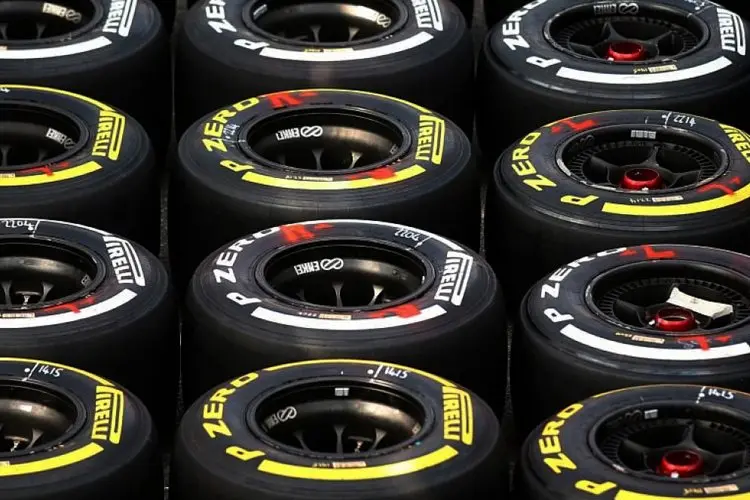
Pirelli have accepted the request to name their Formula 1 race tyres Hard, Medium and Soft in an effort to eliminate confusion that has apparently arisen due to the seven different compounds, with corresponding colours, that are used currently.
F1 officials approached Pirelli to simplify the naming of the tyres while allowing for the range of compounds to be used under the traditional Hard, Medium or Soft nomenclature.
Speaking at a media event in London, Pirelli Head of Car Racing, Mario Isola said, "We understand that for some spectators it's difficult to identify the seven compounds we have in the range."
"What is important is that we don't lose the message that we are not going to different races with the same compound. So we're happy to call them Hard, Medium and Soft, to define three colours and to use the same colours and the same names for all of the races."
"But then we need to find a way to make a correspondence between the name and which is the compound we use because I believe some spectators who are more technical like to go deeper into different detail and what we are using."
"If it is compound A, B, C, whether it's letters or numbers, this is still in discussion. If the desire for Formula 1 is to go in this direction we are happy to follow this request."
With regards to the 2019 compounds, Isola explained, "Ideally we should have six compounds but better space. This year one of the issues is that soft, super and ultra are very close so next year we are working on different compounds to have a bigger gap and generate the famous crossover in order to have different strategies."
"The problem is if you generate different strategies with the same total race time, everybody is targeting a one-stop race. This is something we learnt from the beginning of the season. Looking at the numbers in some races we have a two-stop strategy that was quicker than one stop but obviously you take a lot of risk with an additional pit stop. So if the difference is small, less than five seconds, everyone will target to go on a one-stop race."
"We need to make simulations to have a two-stop strategy that is quicker. It's difficult to understand how much quicker because if it's too quick everyone will do the same two-stop strategy. If it's not enough, everyone will go on a one-stop strategy. We need to find a balance where we have teams approaching the race in a different way."
"The request to have a bigger delta between compounds came from the drivers. When I was talking to them in the drivers; briefing in Barcelona they said some of the compounds are too close and it's difficult to understand exactly which one you want to use during the race. So we tried to select compounds with a bigger delta to see if we are going in the right direction," added the Pirelli F1 chief.
Latest News

Loading