Next year, Formula 1 is entering a new era. There will be new manufacturers, drivers, and rules around the cars, presenting teams with a myriad of issues to tackle ahead of the 2026 season.
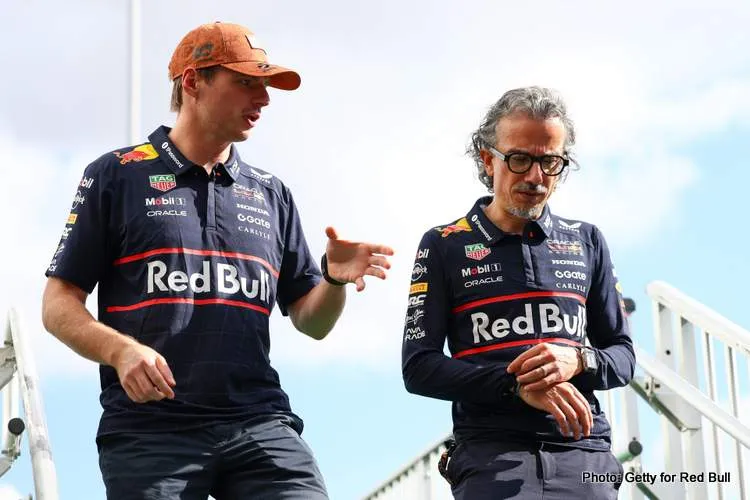
Arguably, Red Bull is facing the biggest challenge of all. Following two glittering spells of success that saw them win eight drivers’ titles and six constructors’ crowns, they’ve lost boss Christian Horner, advisor Helmut Marko, and sporting director Jonathan Wheatley, not to mention legendary designer Adrian Newey.
While the team dominated the last F1 ruleset, winning 21/22 races just two years ago, it has since been shaken by allegations of Horner’s infidelity. These claims caused a huge amount of upheaval, with Jos Verstappen clashing repeatedly with Horner from then onwards. Amid on-track challenges last season, Horner was eventually replaced by Laurent Mekies.
Given that Max Verstappen very nearly fought back to snatch the drivers’ title away from Lando Norris, the new boss has done well so far.
However, Red Bull now faces their first-ever Horner-less season with a new engine and a lot to do ahead of a challenging campaign as they deliver their first F1 car without Newey.
Red Bull chaos cost Max a title?

It’s pretty incredible how much has changed over the last two years. Red Bull easily saw off an initial challenge from Charles Leclerc and Ferrari in 2022 and wiped the floor with the opposition a year later—Verstappen beat second-placed Checo Perez by 290 points.
But allegations against Horner in 2024 rattled the team to its core. Jos Verstappen said the team risked “being torn apart” if the long-serving Brit stayed in the role, yet he remained. Amid reports that Verstappen Jr. was eyeing up a move to Mercedes, Wheatley then left for Sauber.
While all this played out, McLaren stole a march on-track. They weren’t quite fast (or efficient) enough with a clear pace advantage to pressure Verstappen towards the end of 2024, but last year was a different story. Ultimately, Red Bull lost patience amid a lack of competitiveness, relieving Horner of his duties after the 2025 British Grand Prix.
However, the damage had been done. Verstappen missed out on a fifth drivers’ title, quite possibly because of his team. After the season, Marko was also dismissed, prompting further accusations from his side. All this suggests a lack of unity ahead of a critical rule change that will run from 2026 to 2030, where any advantage could be “locked in” for the foreseeable future.
Red Bull’s urgent to-do list for 2026

In-team fighting aside, Red Bull faces significant technical challenges heading into next season. The 2026 ruleset will see cars made lighter, smaller, and more sustainable, with DRS being replaced by a new front and rear active aero system designed to improve overtaking.
Red Bull faces all the same implementation challenges as its competitors, along with huge question marks over its power unit. Though Honda split from Red Bull at the end of 2021, it has still provided technical support for the last three seasons. The Japanese manufacturer is throwing its weight behind Aston Martin next year, while Red Bull partners with Ford.
Honda themselves endured a disastrous comeback with McLaren in 2015. Fernando Alonso famously labelled the team’s power unit a “GP2 engine,” as they failed to really compete from 2015 to 2017. Many insiders are describing the new rules as an “engine formula” heading into the new campaign, so Red Bull needs to ensure their partnership with Ford gets off to a flying start.
Are Red Bull facing the toughest challenge?

There’s no doubting Red Bull’s uphill task, but how are others approaching the new rules? At Cadillac, they face the prospect of joining the grid almost cold turkey. They’ll use a Ferrari power next year and try to integrate their own after that, but it’ll be tough at the beginning.
Audi have a slight advantage, as they’ve had time to experiment at Sauber. However, the team faces the same challenge of taking on F1’s established names especially as they will also be using their own power units from the outset—a prospect fraught with danger for any newcomer.
Having completely failed to get to grips with the last ruleset, Alpine may be welcoming next year’s shake-up, but they too are integrating a new engine. Mercedes reliability comes at the expense of becoming a customer team. This could see the Enstone team return to the front next year (similarly to Williams in 2014) or condemn them to second-tier mediocrity.
There are so many “what ifs” heading into F1’s new era, they almost don’t bear thinking about for Red Bull. At the moment, all that teams can do is maximize what’s under their own control. Time will tell if they’ve developed in the right direction for 2026, but Red Bull need to sort out their internal differences and get an awful lot right if they’re going to compete next year.
loading
Latest News
Loading