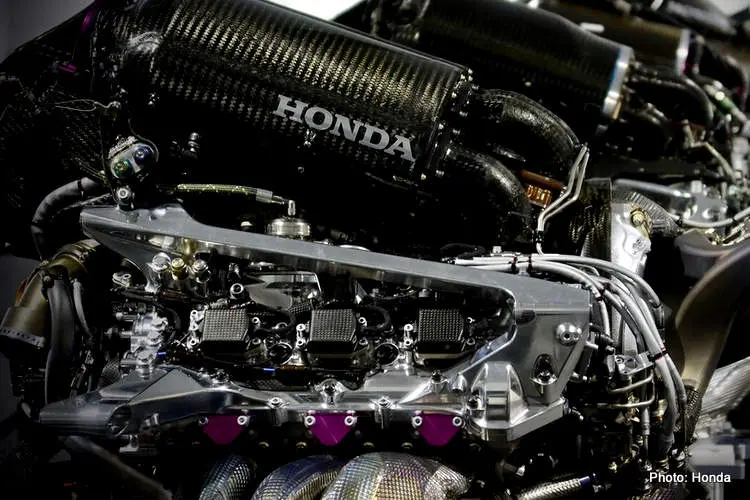
Honda’s preparations for the 2026 Formula 1 regulations appear to be facing significant challenges, as the Japanese manufacturer works on its next-generation power unit that is expected to power Fernando Alonso and Lance Stroll at Aston Martin.
Honda Racing Corporation (HRC) President Koji Watanabe admitted the difficulties during last weekend’s Daytona 24 Hours, where he provided an update to reporters on their progress with the PUs destined for Aston Martin in 2026; he said: “We are fighting. Now we are doing our best to show the result next year."
Honda will exclusively supply Aston Martin with power units for 2026, with the AMR26 set to incorporate their latest hybrid technology. Adrian Newey is expected to play a key role in the car’s design and development.
Watanabe acknowledged the scale of the challenge, adding: “Everything is new. The engine is new, 355 kW (electric), very compact, which is what we need. Also the light battery, which is not so easy to develop… and also the small engine with big power.”
Under the new regulations, the internal combustion engine’s output will drop to around 475 hp, a significant reduction from the current near-800 hp. However, the hybrid system will see a major increase, with electric power rising from 180 hp to approximately 475 hp.
“It’s all very difficult, but we’re doing our best,” Watanabe went on, in a statement that hinted at ongoing struggles. Honda’s challenges mirror those faced by Red Bull, whose RB Powertrains division—developing their first in-house engine in collaboration with Ford—is also encountering difficulties in adapting to the new technical framework.
Honda currently possesses one of the most powerful engines in F1, regarded as second only to Ferrari. Their power unit is estimated to be ahead of Mercedes and holds a roughly 50-hp advantage over Renault’s (Alpine).
Is a repeat of 2015 on the cards?

Their initial return to F1 in 2015 with McLaren was plagued by reliability and performance issues, leading to an unsuccessful partnership that lasted until 2017. A move to Toro Rosso in 2018 provided a stepping stone before Red Bull adopted Honda power in 2019. With support from AVL, Honda refined their engines, securing victories in Austria, Germany, and Brazil that year.
Since 2022, Honda’s power units have dominated the grid, culminating in a record-breaking 2023 season with 21 wins from 22 Grands Prix. However, the 2026 regulation changes will reset the competitive order, making past achievements no guarantee of future success.
Adrian Newey, speaking this week to Auto Motor und Sport, emphasised the importance of getting the engine concept right for 2026; he pointed out: “There is the possibility that someone comes with a dominant combustion engine that lasts the whole regulation because it is difficult for the others to catch up coming from behind."
Newey’s comments highlight the significance of the upcoming power unit era and suggest that he is closely monitoring Honda’s progress. With Aston Martin banking on their new partnership, the question remains: will Honda overcome its current challenges and deliver a competitive engine for 2026?
Or will Fernando Alonso be calling it "a GP2 engine" again? As he did a decade ago, when Honda's feeble Power Units powered the Spaniard's McLaren, through the darkest days of his illustrious career in F1.
Latest News
Loading