Outside Line: Total respect for last of F1's old guard Helmut Marko
F1 NewsWednesday, 02 April 2025 at 14:52
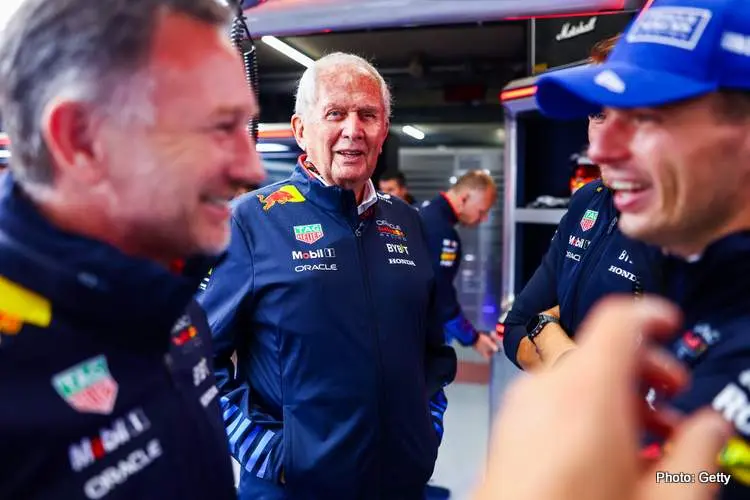
There’s no one quite like Dr Helmut Marko in the modern Formula 1 paddock. A Le Mans winner turned uncompromising talent scout, the Austrian has forged a legacy not by chasing popularity, but by shaping champions.
As Red Bull’s motorsport consultant and the architect of its racing driver development programme, Marko has played a decisive role in the careers of Sebastian Vettel and Max Verstappen. He’s also been the source of controversy, criticism, and no small amount of media intrigue.
But at 80 years of age, Marko remains as sharp, outspoken, unapologetically old-school as ever and grabbing headlines regularly.
In an era increasingly defined by corporate polish and PR sensitivity, Marko is one of the last relics of a bygone F1 generation—a man who says it as he sees it, can be uncompromisingly ruthless, and sees the world through the hard-earned lens of a driver who survived the sport’s most dangerous days.
Whether you admire his tough love, some call it bullying others bristle at his bluntness, Marko has carved an incredible legacy in Formula 1. He reminds us that being a 'good cop' does not mean zilch in an era when results mean everything, that motorsport is not for sissies, even more so Formula 1 with only 20 seats available at the pinnacle.
From the streets of Graz to the top step of the Le Mans podium

Marko’s story begins in post-war Austria, born in Graz on 27 April 1943. As a schoolboy, he struck up a friendship with Jochen Rindt, a bond that would shape the course of his life. While Marko pursued a doctorate in law, eventually earning his title of "Dr Marko," it was Rindt’s exploits in Formula 1 that rekindled a latent passion for racing. By the late 1960s, Marko had traded legal textbooks for overalls.
Marko's greatest triumph as a driver came in 1971 when he partnered Gijs van Lennep to win the 24 Hours of Le Mans in a Porsche 917K. The pair set a distance record that stood for nearly four decades. But just one year later, Marko’s career was cut short.
At the 1972 French Grand Prix, a stone pierced his helmet visor, blinding him in his left eye. It was a cruel end, all the more so because he was reportedly on Ferrari’s radar. The experience hardened Marko—physically and mentally.
He had lost not just his own future behind the wheel, but also many young drivers - his friends - he would later support as a team owner in the deadly 1960s through the 1970s and early 1980s. Helmut Koinigg, Markus Höttinger, Hans-Georg Bürger—all killed in crashes. Marko, the survivor, became a man less inclined to indulge in sentiment and more driven to produce results.
The 'bad cop' behind Red Bull's racing driver empire

In the 1990s, Marko made his mark in Formula 3000 and helped shepherd talents like Juan Pablo Montoya and Jörg Müller.
But the big break came when fellow Styrian, Dietrich Mateschitz, founder of Red Bull, entrusted him with the Red Bull Junior Team in 1999. That relationship would transform not just Marko’s career, but the entire driver development landscape in Formula 1 to this day and for the foreseeable future.
When Red Bull entered Formula 1 in 2005, Marko was named their motorsport advisor. What that really meant was this: no driver joins, leaves, or gets promoted within the Red Bull Racing or Toro Rosso (now Racing Bulls) structure without Marko’s say-so. While Christian Horner manages the race team, Marko governs the driver pyramid. And when he speaks, it’s usually final.
History shows he’s the reason Sebastian Vettel got his Formula 1 chance. The reason Max Verstappen raced in Formula 1 at just 17. The reason drivers like Daniil Kvyat, Pierre Gasly, and Alex Albon rose—and fell—so quickly. Marko’s philosophy is brutally simple: Formula 1 is a meritocracy. If you don’t deliver, you’re gone.
That approach has earned him both admiration and enemies. Some say it’s cutthroat, even callous. Others, including many of his champions, say it’s the standard that greatness demands. What’s indisputable is that Red Bull’s conveyor belt of talent—led by Marko—has produced more winners, poles, and titles than any other development system in the sport.
Marko, Vettel and the Webber tension

Marko’s fondness for Sebastian Vettel was and is no secret. He scouted the young German early and fast-tracked him through the Red Bull system. When Vettel rose to dominate Formula 1 from 2010 to 2013, Marko’s influence was plain to see.
He shielded his protégé from criticism and backed his aggressive instincts—most famously during the "Multi-21" saga in Malaysia, where Vettel ignored team orders to overtake Mark Webber.
The Australian had to show his True Grit, when often he felt like the second son in the Red Bull household. Webber later admitted that Marko’s perceived favouritism hastened his decision to retire. The team's advisor, typically, made no apology. He had chosen his horse, and Vettel delivered titles.
A similar loyalty emerged with Max Verstappen. Marko took a huge gamble in 2014 by signing Verstappen straight from European F3, leapfrogging more experienced drivers. Critics howled.
After Toto Wolff took a pass after the Verstappens visited his home in Austria, the Mercedes boss banking rather on Esteban Ocon. In contrast, within minutes of meeting Jos and Max, Marko didn’t blink. Verstappen would become the youngest at just about everything in Formula 1 and was a Grand Prix winner at 18.
By 2021, he became an F1 World Champion for the first time. Now a four-time champion, Verstappen is the embodiment of Marko’s philosophy: talent plus toughness equals triumph.
Controversies that won’t go away

Marko’s public comments have, on occasion, landed him in hot water. During the COVID-19 pandemic, he floated the idea of a "Corona camp" to expose young Red Bull drivers to the virus—believing they’d develop immunity while the season was paused. The backlash was swift. Red Bull quickly distanced itself from the suggestion.
In 2023, he caused an uproar when he suggested Sergio Pérez lacked focus because he was "South American," despite Mexico being in North America. The comment was widely condemned as offensive and factually wrong. Marko apologised publicly, and Pérez accepted.
But the episode added to a growing list of criticisms that Marko’s unfiltered style belongs to a different era. And maybe it does. But the results endure.
With the passing of Mateschitz in 2022, many wondered whether Marko’s influence would wane. Instead, it held firm under heir Mark Mateshitz who appears to value the loyalty of his father's mate.
Despite corporate reshuffling within Red Bull, Marko remains the senior voice in racing operations. He continues to monitor junior talent, mentor Verstappen, and assert his views—publicly and privately.
Eternal respect

There’s speculation that his protege Vettel could one day replace him in the Red Bull advisory role. If that day comes, it will mark the end of an era.
Marko is not just a consultant; he is part of Red Bull Racing’s living legacy, the man who’s been there since the beginning. He’s part team principal, part talent scout, part provocateur. And entirely irreplaceable.
As the sport changes around him. Getting more 'woke' and more commercial. More polished, more managed and curated, Marko endures when many of his generation that are still around are all but forgotten. The man who scoffs at PR fluff and judges by stopwatch.
The 'Verstappen Story' may well be the last chapter of Marko’s Formula 1 career. How can the Doctor beat that combo? In my book, Marko will be remembered not for the controversies, but for the champions. For his role in building an empire that defied the establishment. For being the last of the old guard in a sport that sometimes forgets what made it great in the first place.
Dr Helmut Marko may never win a popularity contest. But in the results business of Formula 1, no matter what the British media write, no matter what 'woke' fans moan about, no matter how politically incorrect he may be, like him or not, he deserves eternal respect from all who follow and love our sport.
What are your thoughts on Helmut Marko?
Latest News
Loading