After a long and demanding 2024 season, Haas F1 Team has taken significant strides in strengthening its internal operations. The technical team reflects on key successes and the improvements made both on and off the track.
Andrea De Zordo as Technical Director and Head of Aerodynamics Davide Paganelli are the unsung heroes who were vital to the resurgence of Haas last season, and the engineers in charge of taking the concept to the next and final level in 2025 with the VF-25.
Looking back on 2024, De Sordo said: "2024 was a very long year, but for me, the relationship between the Italian HQ and the UK HQ was probably the best thing about last season. We’re a lot more aligned, we discuss a lot, and I think it’s a relationship that is working well.
"We’ve improved a lot the strength of the design office, we’ve improved a lot our aero in terms of methodology, tools, and that’s a process that started already some time ago, and although we still have a lot to do in that respect, we are on the right path.
"On track, the result was great. It was better than anyone could’ve initially hoped for, and although we didn’t obtain sixth place, in general it was a great year," ventured De Sordo.
Post-Steiner era, Haas has gone from strength to strength

Paganelli summed up from his end: "Last year we grew a lot in terms of design resource and we also gained a lot of confidence that we can definitely do better. The mood in the design office today is absolutely positive, we can feel the energy here. Last season we were able to demonstrate to ourselves and the rest of the grid that we can do a very good job.
"We consider 2024 a success because we came into this season being last in the championship. It was really difficult to be able to deliver something positive with the same resource, but by changing the organizational structure we unlocked the potential of team members, and that was really satisfying," he added.
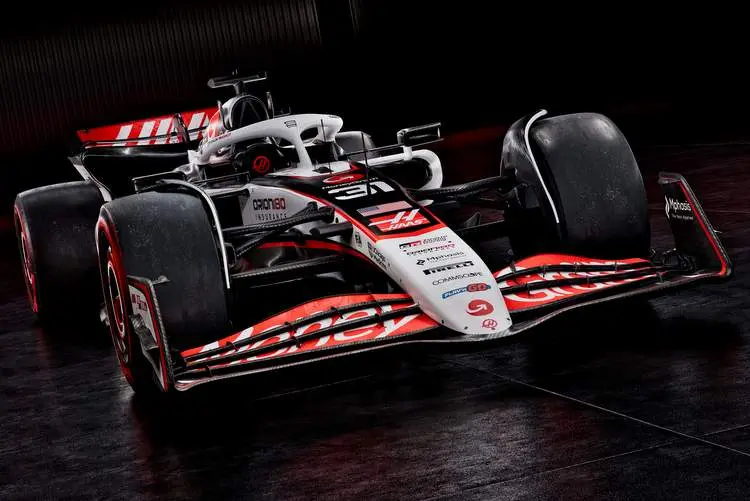
Haas has taken a targeted approach to refining its 2025 challenger, with a particular emphasis on aerodynamics and overall efficiency. De Zordo and Paganelli outlined the key developments that will shape the team's performance in the upcoming season with the VF-25.
De Zordo revealed: "The main performance contribution comes from the aero side, so the main point of focus has been again trying to grow in that area as much as possible. In parallel to that, every year we try to write down a point or quality of the car that isn’t good, so every year we try to improve the general quality of it, fixing small problems that may be a small thing, but all together improve the car.
Trackside operations need to be improved

"Another important fact that we know is last year the car had some specific limitations and we tried to do some specific work to try to address that area, and we’ll see the result of it. Finally, I think we can say that we need to improve our trackside operations. Sometimes last year we weren’t perfect, and left some opportunities, so we need to improve in that respect also," he explained.
Paganelli cotinued: "Our focus was the points of weakness identified in the VF-24. With the help of the performance team, we tried to work on the whole car as a package to be able to solve the issue. An indication of this is that we worked a lot on the rear of the car, and particularly the rear wing. I think that we’ve done a really good job on this for 2025.
"We believe the package we’ve designed is a really good one in terms of development. Obviously, we must check if the delivery is what we expect. If we’re able to see on track what we think we're discovering in the wind tunnel, I think that we can have a massive boost from the very first race."
Adjusting to new drivers in the VF-25

With an all-new driver pairing for 2025, Haas faces the challenge of adapting to fresh feedback and new driving styles. The technical team acknowledges the learning curve ahead but remains optimistic about the transition.
De Zordo stated: "For sure, we’ll need a little bit of time just for both sides of the garage to become familiar with their new drivers. It takes some time to ensure the small things are sorted, like making them comfortable in the car, and how they like certain processes etc.
"I’ve found them both to be very committed, smiling and motivated, and that’s left all of us with a good impression and a good feeling for the year. All these points help with motivating the team – and that’s so important when things aren’t going well, or people get tired during a long season."
Paganelli echoed his colleague's sentiments, he added: "For us, it’s not been a challenge designing for different drivers. We try to design the car to improve the weakness we have. We are sure that the new drivers have a lot of capability. They’re really, really good drivers and they can provide excellent feedback and also help us to go even further in the understanding of the car."
The competition in 2025 is expected to be as fierce as ever, with the midfield battle tighter than before. Haas aims to make the most of every opportunity in a highly competitive field.
"I expect it to be a very, very tough season – a tight field and strong competition," De Sordo said. "Every point will be a battle, and we need to be perfect. We need to be focused from the beginning and not leave any opportunity, because it will cost us."
Work already started on our 2026 car

Paganelli ventured: "We want to improve what we did last year and to be able to build again as a team. Continuing to work on the relationship we were able to find in working together better, ready for the next challenge ahead, which comes in the shape of the 2026 regulations."
As 2026 draws closer, teams must balance the demands of their current cars with the significant technical changes looming on the horizon. Haas has already begun work on the next generation of Formula 1 machinery, De Zordo revealed: "It’s been discussed for some time now because there’s been a big job with the FIA to define the rules.
"The challenge is huge, there are very big changes and the new aero platform, new rules on how to manage aero plus how to manage energy, and it’s a completely different way to do it from a performance point of view. I say challenge, but it’s going to be a fun one."
The VF-25 has not even run in anger, yet Paganelli confirmed: "We’ve already started working on our 2026 car, as FIA regulations permit teams to start working seriously on the project in terms of aerodynamics from January 2, 2025. We started doing both the simulation and started preparing the wind tunnel activities for the new car."
"We know that because the competition will be very tight, we have to provide in-season updates, and we’ll try to use the same philosophy as the previous year, ensuring we’re happy with the direction and we can see results before proceeding with further updates," concluded Paganelli.
Haas VF-25 Photo Gallery


Latest News
Loading