Exclusive Nicola Larini: On Karting, F3, DTM, F1 and Imola 1994
F1 NewsThursday, 26 September 2024 at 13:26
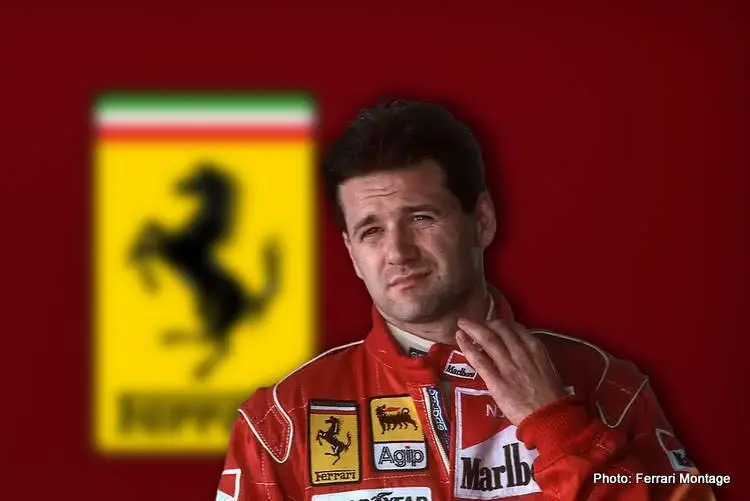
Nicola Larini was born on March 19, 1964. He made his F1 debut with the Coloni team in 1987 and drove for five other teams for a total of 49 Grand Prix starts.
There was no joy in his only podium which came at Imola in 1994. Italian F3 & DTM Championships were the highlights of his racing career. Today, he is helping his son Davide climb the racing ladder.
[GRANDPRIX247's Historical Correspondent (and the voice on 1000 podcasts over at F1 Weekly) Nasir Hameed caught up one-on-one with Nicola at the recent Italian F4 race at Mugello.]
Nasir: Good to meet you. How are you today?
Larini: "Personally, I'm fine. Not really happy about the race result about my son, unfortunately he got a penalty in the race. So, we are going for the next one and in one hour I wish a better result for him and also for me because I like to see good results."
Nasir: How good is Davide compared to Papa at the same age?

Larini: "It's not easy. So now he's 16-years-old; when I started my career, I was 18 so I know it's completely different; it's difficult to make a comparison because it's different times. Today they start when they are eight years old."
Nasir: Did you push him to go into racing, or did he push you to let him race?
Larini: "Honestly, I don't know. It just happened."
Nasir: Can you tell us a little bit about your Karting career? How long were you in karting?
Larini: "I started in karting really late; I was 14 years old. So, for example, now they start at seven years old. So, at 12 they are already in racing many, many years. This is the reason why at 15 years of age they are ready to drive a Formula 4 car like this. This is a very competitive car. They are fast. They are faster than my Formula 3 car. If I compare my lap time 40 years ago, they are five seconds faster."
Nasir: How important was the role of Enzo Coloni in your racing career; you won the Italian Formula 3 championship with his team and also got into Formula 1 with his team?
Larini: "When I joined him, I had good a sponsor and good support, and I had the best car in the field. The target was to win, and I won. So, that was the Italian Championship, and Enzo was working on his Formula 1 project. I'm being his first driver for that project. In 1987, we tried to do Monza. But fortunately, the car was not ready. And then we went to Spain. In Spain, we were doing a good race and retired with mechanical problems, but we were already in midfield. So, after that, I got the opportunity to continue with other teams. But, of course, Coloni has been my first big sponsor for my career."
Nasir: Your Grand Prix debut at Jerez. What was the biggest surprise upon reaching the Formula 1 grid?

Larini: "My first experience has been, you know, in Monza, fighting for qualifying. Honestly, I don't remember what's happening around, but I know that there was a big opportunity to become one of the top drivers in the world. It's always been an important moment for me to achieve goals for the future."
Nasir: From Coloni you moved to Osella. When you were racing for a small team that does not have the budget of big teams, how does the driver keep his motivation high knowing that you don't have the equipment to fight for points?
Larini: "Of course, in the past you could have the opportunity to drive for a small team. But this was the ticket to get in Formula 1. Now it is impossible. There are only 20 cars and only 20 drivers. In 1980–89, there were 26 drivers and 26 cars, so it was completely different. There was more opportunity for a young driver to try to get into Formula 1. Of course, to score a point was a bet. For example, with Osella, I've got this big opportunity in Canada, when we were third after three quarters race, then we got a technical problem. But, you know, of course, that for me was like a business card; to show the other team that I was good, unfortunately, Osella lost the opportunity to gain points and access to be a top 10 team."
Nasir: Next you raced for a French team, how was it to work for Guy Ligier?

Larini. "It was not easy. The only positive I can say for me was a way to learn French because I had never studied French. So, in one year, I was able to speak in French to everyone. Of course, it was not easy; the team was not in the right condition to be faster because the car was coming from the previous season. And if I remember also the season before, it was very old with, you know, an eight-cylinder Cosworth that was at the end of its life.
"It has been a very nice season for me because I'm one of the drivers that did the most mileage. I did three times seventh, unfortunately, the points were only given up to sixth position, so now it's different, now you can you be 10th. and you get one point. But, anyway, with Ligier it was a nice experience for me, and it has been a big improvement because I was really in a professional team apart from car's competitiveness."
Nasir: In 1992, you replaced Ivan Capelli for the final two races of the season. As an Italian driver, it must be a source of great pride for you to drive for Ferrari. Can you tell us about these two races? And was there any chance of becoming a full-time driver for Scuderia in 1993?
Larini: "Of course, I was test and third driver at that moment. I replaced Ivan Capelli; for the last race of the season because there was a new car with the active suspension. And I was developing this new suspension for 1993. The team decided because they were not competitive, so they decided to go to Australia and Japan with this car to go straight in the race and to see how the performance was and if they were ready in this direction.
"For 1994 I replaced Jean Alesi because he was injured testing here in Mugello. (The French Ace from Avignon was on the podium in the Interlagos season opener and missed the Pacific and San Marino Grands Prix). That races were for me difficult because the car was good, not so bad. I've got a good opportunity also in Japan, but unfortunately, I was involved in a first-corner crash between Hakkinen and Senna, so I didn't race, I did only 50 meters. Race 2 was in Imola, and you know the story."
Nasir: That was going to be my next question, difficult to ask and maybe difficult for you to answer. Can you describe being on the podium at Imola? The mood on the podium among the drivers and the atmosphere in the paddock after the race?

Larini: "It was a nightmare. The atmosphere was really bad, first of all, for the accident that we got in the race weekend from Friday, Barrichello, then Ratzenberger. And then during the race, after the start, my mechanics in the hospital for a problem in the pit lane. And then Senna. I think, a black week like this. I don't know. I don't remember. Also going into the past, it has been a very difficult race weekend. Of course, for me also, it has been my best race in Formula 1, my best result. Okay, for this reason, it didn't do anything for the future because no one can remember my result but only what's happened. Negative."
Nasir: Okay, I saw your DTM championship-winning car at the Alfa Romeo Museum in Arese a few years ago. What are your best memories from that season?
Larini: "Yeah, after the Formula 1 experience, after the Lamborghini experience, I decided to stop my Formula 1 career because it was not possible to continue in a team without money, so the reason why I'm became the third drive for Ferrari and at the same time back with Alfa Romeo as a full season in the form of a touring car in 1992. First of all, in the Italian Championship, and then in DTM for three years. Yeah, that has been an important moment of my career because I finally got the opportunity to drive a good car and to be the best in the field."
Nasir. Italian motor racing history is incredible. Nuvolari, Monza, Mile Miglia. Three of the first four championships were won by Italian drivers, Farina and Ascari, but no Italian World Champion since 1953. What can be done to change that? And do you think Kimi Antonelli will be the next Italian F1 champion?

Larini. "After years without an Italian in Formula 1, the last one was Giovinazzi, I hope that Antonelli can be the future for Italian drivers in Formula 1. I know that it is not easy, but he has the backing of one of the biggest car manufacturers, so I think if he is good, he can be in Formula 1 for many years. And maybe to try to become a world champion."
Nasir: Motor Racing has always expensive, now it's totally out of control. But we have Driver Development Programs from Red Bull and other teams. Is it easier for young talented drivers to get into racing now or in your days?
Larini: "I tell you honestly, this world is completely changed. Now if you want to be in, for example, the Italian Formula 4 Championship, if you go and read the drivers names, there are 37 drivers, only three Italian drivers, including my son, and the rest have come from worldwide. So this means that the Italian Championship is one of the most important for developing young drivers for the future, but to be in the top team to win it's not easy because you need unlimited budget. Of course, you have to be right; you have to be faster, but it's not enough. You need money, money, money. Everything changed when Stroll started racing in 2014. Now it's not possible to be here just because you're only faster. You need the money, a lot."
Nasir: Lewis Hamilton is going to Ferrari. Did that surprise you? And do you think he'll win a championship with them?
Larini: "I wish for him because I saw last time he showed the world he is still good for fighting. But Ferrari for many years have not been able to have a really consistent race winning car. Okay, they can win some races, but they are not on top to be able to win championships. So, I wish for him all the best. I think for a driver like him, it was a dream. It was a dream to finish a career in the red. But, never say never. We will see."
Nasir: I'm sure you remember the fight between Gilles Villeneuve and Rene Arnoux at Dijon-Prenois 1979. Today, we have drivers constantly complaining—oh, he pushed me off the road, and there are penalties all the time. What do you make of that?
Larini: "As I told you, everything has changed. Yeah. Now if you push a little bit penalty, if you go two centimeters off the line penalty. So now they are going to replace tarmac with gravel again as in the past because that has been a very stupid idea to avoid this kind of problem, but of course the stones are dangerous, but also in the past, so I think going back a little bit with the old style is good for motor racing."
Nasir: Final question: Your favorite Formula One track?
Larini: "Spa-Francorchamps."
Latest News


Loading