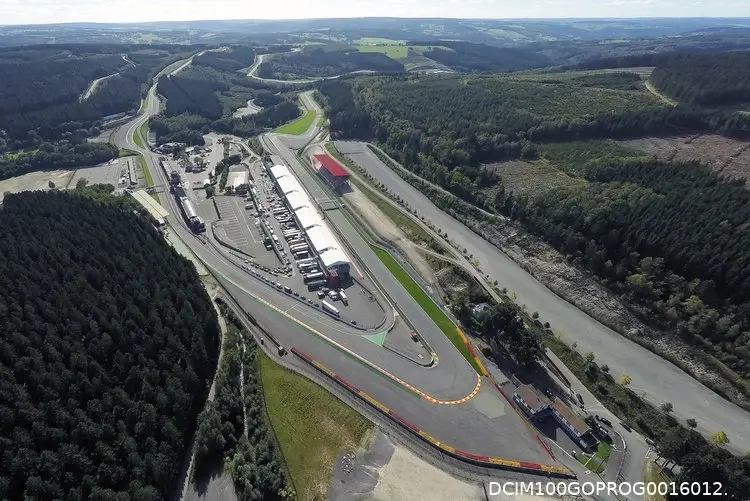
Those toiling within the globe-trotting FIA Formula World Championship earned a three-week reprieve following the July 29 Hungarian Grand Prix in Budapest, the mandated summer shutdown allowed crew members to reacquaint themselves with their families and recharge prior to the stretch run of this year’s 21-race calendar, which resumes this weekend with the Belgian Grand Prix at Circuit de Spa-Francorchamps.
Measuring in at 7.004 kilometers (4.352 miles), Spa is the longest venue in Formula One, outdistancing the series’ second-longest track, the 6.003-kilometer (3.730-mile) Baku City Circuit, by 1.001 kilometers (.622 of a mile). In addition to its length, Spa is known for its reputation of being a driver’s track, thanks in large part to the addition of the signature Eau Rouge and Raidillon corners in 1939, which created a fast and sweeping uphill, left-right-left combination that drivers view with reverence and attack with gusto.
Spa has hosted Formula One since 1925, with last year’s Belgian Grand Prix serving as the venue’s milestone 50th grand prix.
The Essentials
Focus points Straight-line speed. The cars are flat-out for large sections of the lap (22s in Sector One and 19s in Sector Three), so the main focus for the engineers revolves around how much downforce to strip off the car while continuing to give the drivers a compliant machine through the high-speed twists of Sector Two.
Unique difficulty No other corner in F1 resembles the legendary left-right-left flick at Eau Rouge. It’s been eased over the years, making it slightly less of a challenge, but the g-forces and the incline remain unique. The drivers approach the corner at 310km/h (190mph) and they experience a 2g compression at the bottom of the hill, before being subjected to 4.6g lateral through the right-hander, while climbing 190 feet towards the exit at Raidillon.
Biggest challenge The weather. The track is located in the Ardennes, a mountainous region of Belgium that’s infamous for its unpredictable micro-climate. Rain has become a regular feature of the race and it was at Spa-Francorchamps in 1997 that the first-ever Safety Car start took place on a water-logged track. Complicating matters further, the track is often dry in one section and wet in another, forcing the drivers and engineers to think on their feet.
Engineer's Lowdown
Braking Light. There are nine braking zones at Spa-Francorchamps, but only three of them are heavy braking events. Only 13 per cent of the lap is spent braking, which is similar to Suzuka in Japan.
Power The cars use 2.2kg of fuel per lap, which is high - and can be explained by the long lap and the high percentage of full throttle.
Aero Low downforce. Spa-Francorchamps has one of the highest average speeds of the season at 240km/h (149mph) and more than 70 per cent of the lap is spent at full throttle. These factors push the cars towards the lower end of the downforce spectrum. How low? That depends on a car’s horsepower and the amount of aerodynamic drag it generates.
Statistics for Sunday’s Belgian Grand Prix at Spa-Francorchamps:
- Lap distance: 7.004km. Total distance: 308.052km (44 laps)
- 2017 pole: Lewis Hamilton (Britain) Mercedes one minute 42.553 seconds.
- 2017 winner: Hamilton
- Race lap record: Sebastian Vettel (Germany) one minute 46.577 seconds (Ferrari, 2017)
- Start time: 1310 GMT (1510 local)
Belgian Grand Prix
- This year’s race will be the 51st Belgian Grand Prix at Spa and eight of the last 16 have been won from pole position.
- Mercedes have won the last three Belgian GPs. Ferrari have not won at Spa since Kimi Raikkonen in 2009.
- Michael Schumacher won a record six times at Spa, including from 16th on the grid in a wet 1995 race.
- Three Belgians have finished on the podium in their home race — Paul Frere, Olivier Gendebien and Jacky Ickx. McLaren’s Stoffel Vandoorne is the only Belgian on the current grid.
- Spa is the longest lap of the season and one of the fastest, with an average speed of around 230 kph. Cars are flat out for about 70 percent of the time.
- Four current drivers have won at Spa: Raikkonen (2004, 2005, 2007 and 2009), Hamilton (2010, 2015, 2017), Vettel (2011, 2013) and Daniel Ricciardo (2014).
Race Victories
- Hamilton has five wins this season to Vettel’s four. Red Bull’s Ricciardo has two and Max Verstappen one.
- Hamilton has 67 victories from 220 races and is second in the all-time list behind seven-times world champion Schumacher (91). Vettel has 51, Ricciardo seven.
- Raikkonen has now gone 106 races since his last win, in Australia in 2013.
- Ferrari have won 233 races since 1950, McLaren 182, Williams 114, Mercedes 81 and Red Bull 58. Former champions McLaren and Williams have not won since 2012.
Pole Position
- Hamilton has a record 77 career poles, Vettel 55.
- Verstappen, at 20-years-old, can still become the youngest ever pole sitter this season. The current youngest is Vettel, who did it at the age of 21 years and 72 days.
- Verstappen’s birthday is on 30 September
Podiums
- Hamilton has 126 career podiums and is second on the all-time list behind Schumacher (155). Vettel has 106, Raikkonen 99.
- Mercedes’ Valtteri Bottas has had five second-place finishes in 12 races.
- Raikkonen has been on the podium in his last five races.
World Championship Points
- Hamilton on 213 points after 12 rounds leads Vettel by 24 points.
- Mercedes are 10 points ahead of Ferrari in the constructors’ championship.
- Russian rookie Sergey Sirotkin (Williams) is the only driver yet to score a point this season.
Milestones
- Raikkonen can take his 100th career podium finish in Belgium.
- Hamilton has 39 fastest laps and can become only the fourth driver to reach 40. The others are Schumacher (77), Raikkonen (46) and Alain Prost (41). Vettel is on 34.
Belgian Grand Prix Technical Preview by Iman Hansra

Spa-Francorchamps is a very unique Formula One track, placing all aspects of a car under the greatest scrutiny. Firstly, the percentage of the lap spent at full throttle is very high, meaning a potent power unit is critical to lap time, with the Energy Recovery System playing an important role. At the same time, there is a combination of both slow and fast corners. The middle sector is potentially the most exciting third of a lap raced all year, with high-speed, flowing corners and significant downhill slopes.
Downforce vs Drag
- The downforce required for a strong middle sector as well as lower tyre wear must be traded off against the top speed dependent sectors one and three.
- Red Bull used their 2017 Spa rear wing at Paul Ricard and Silverstone on one car, and given the even more top speed dependent nature of Spa, the team could try its Monza spec wing as another option, providing a more raceable car along the straights on Sunday, knowing that the Mercedes and Ferrari Q3 power boosts would see them ahead in quali anyway.

Car Strengths Needed
- Firstly, high straightline speed, from low drag and a potent power unit – there is a 2 km flat-out section from La Source to Les Combes.
- Good high speed balance and downforce for the middle sector – understeer in the less aerodynamically able cars is a laptime killer at Spa, but at the same time a driver must have confidence in their car’s rear end sticking to the tarmac.
- Braking stability – as at any track with long straights, there are significant deceleration events during the lap, in this case into Turns 1, 5 and 18.
Key Corners
- Turn 1 – a good exit from La Source can be carried all the way up Eau Rouge and along the Kemmel Straight. Conversely, poor traction here results in overtaking opportunities for following cars.
- Turns 10 and 11 – this downhill double left hander, known as Pouhon, will be a critical performance differentiator between cars and drivers and should be flat-out for the front running teams.
- Turns 18 and 19 – the Bus Stop chicane requires tidy, late braking, and then a strong front end to ride the kerbs, before good traction to propel the car down the pit straight.
Tyres

- Although the compound names are a step harder than for Belgium last year, due to the tendency towards softer compounds for 2018, the tyre selection is effectively the same as in 2017.
- A one-stop strategy was already possible in 2017 using the US and S compounds, and given improved tyre management strategies and the much cooler temperatures forecast for this year’s race, there is no reason to expect teams to attempt a two-stop unless the conditions result in significant tyre graining or there is a mid-race safety car.
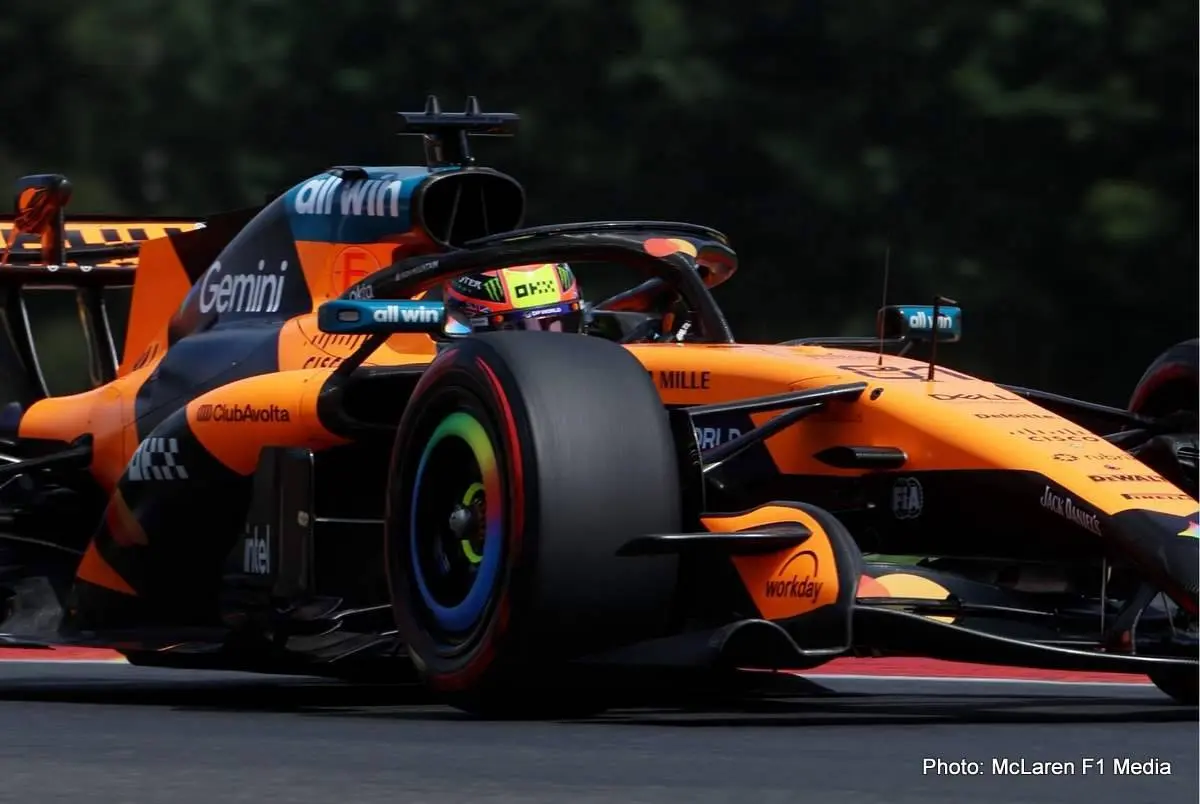
- McLaren has opted for very few sets of the SuperSoft compound, suggesting it plans to run the race purely on the Soft and Medium tyres, allowing the drivers to push harder over a race distance, but at the cost of initial stint performance

Overtaking/DRS
- There are three overtaking opportunities – two after the DRS zones into Turns 1 and 5, and the other into the Bus Stop chicane after the long flat-out Blanchimont section.
- Good racing is made easier by the fact that both DRS zones are preceded by very slow, second gear corners, allowing cars to follow more easily (note that Eau Rouge is not classed as corner sequence here as it will be flat-out for all cars in the dry).
Weather
- All three days are forecast to be cool with the possibility of rain on each day. Saturday looks to be particularly poor with temperatures barely rising above 10 degrees Celsius.
- Thus could make tyre preparation for a qualifying lap critical, and result in quicker out-laps than usual if the session is dry.
- For the race, front graining may become a limiting factor for stint lengths, while it would also bring the softer compounds more into play as race tyres.
Form Guide
- Spa-Francorchamps is similar to Silverstone in terms of its track layout and full throttle percentage, suggesting a close battle between Mercedes and Ferrari. However, if rain arrives, the former may be in a stronger position based on qualifying at the Hungaroring.
- The Mercedes and Ferrari powered teams should feature strongly, although within these outfits Aerodynamic efficiency on the chassis side will be of importance.
- McLaren and Toro Rosso are both likely to suffer with their straightline speed deficit, as evidenced earlier in the year in Baku.
Additional Sources: Haas F1 Team & McLaren Media Offices
loading
Latest News
Loading