Audi: Everyone pushing at full speed looking forward to our F1 debut
F1 NewsWednesday, 09 October 2024 at 11:34
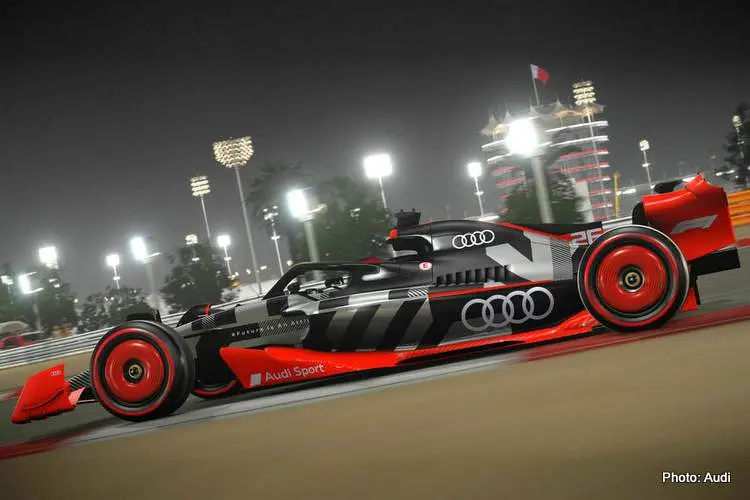
The CEO of Audi Formula Racing, Adam Baker and Audi Technical Director, Stefan Dreyer provided an update and insights regarding the first phase of the development of their Formula 1 Power Unit.
Sauber exists for one more season, at the end of 2025, from 2026 the Hinwill base will be emblazoned with Audi logos as the German auto manufacturer makes its first foray into Formula 1 as a constructor, after huge success over the years in WEC prototype and GT racing.
Since the project was launched, Audi sacked their first team principal Andreas Seidl, who was replaced by former Ferrari F1 boss Mattia Binotto. Also heading to Switzerland is Red Bull's sporting guru, Jonathan Wheatley.
They mean business as the 'ship' seems to be steadied in the aftermath of Seidl's departure. News to emerge is that Audi engineers have already fired up their F1 Power Unit on a dyno, where Grand Prix race distances have also been simulated successfully.
Q&A Audi F1 duo Baker and Dreyer

Work on the development of the Audi Formula 1 power unit has been underway at the Neuburg plant since spring 2022. What results have been achieved so far?
Baker: After just two years, our hybrid power unit, consisting of an electric motor, battery, management electronics, and combustion engine, is operational on the test bench. The successful coupling of the various components is the result of hard teamwork. The Audi power unit has already completed simulated race distances on the test bench. In 2023, we spent a lot of time developing the individual components and were able to transfer the experience gained into the subsequent coupling steps. Significant milestones and objectives have been achieved.
Dreyer: We have radically modernised and expanded the power unit development facility. Today, we have 22 state-of-the-art test benches that have enabled a very steep learning curve. By testing on the bench under simulated race conditions, we have gained valuable know-how. After successfully completing race distances with the power unit, we will soon do the same with the entire powertrain, i.e., the combination of power unit and transmission. At the same time, we are forging ahead with the pursuit of maximum performance so that we can achieve all the goals we have set ourselves.

On which tracks has the Audi power unit already been virtually brought?
Dreyer: Our power unit runs on the dyno with programs that are different from the current F1 calendar, adapted to the purpose of the tests. Las Vegas, for example, is interesting in terms of overall energy management. Several alternating corners, with more or less fast runs, and almost two kilometres at full throttle along the Las Vegas Strip are the ideal environment for fine-tuning the combustion engine and the ERS (Energy Recovery System) components.
Baker: Feeling the Audi power unit revving at full speed while simulating tracks like Spielberg, Singapore, or Las Vegas not only gives you goosebumps, it also gives you the feeling of being one step away from the first race of 2026.
How is the development department organised?
Dreyer: It was particularly important to create a broad basis across all areas so that the individual components (combustion engine, electric drive, battery, management electronics, software) can be carefully developed and then coordinated with one another. The experience gained in previous motorsport projects with high-voltage technology—Le Mans, Formula E, and Dakar—has been invaluable. We have already shown in the past that we can develop successful conventional, hybrid, and purely electric powertrains. However, Formula 1 is fundamentally different in terms of technology and competitiveness. This also applies to our partners and suppliers: we are seeing an extraordinary commitment from everyone.

Even though the Neuburg facility has been completed, will the intensity of Audi's commitment increase further?
Baker: Since the start of the project in spring 2022, we have reached key milestones almost every month: laying the foundation stone for the new infrastructure, starting individual cylinder testing, testing both the electric motor and the V6 on the dyno, and completing the first race distances with the complete power unit. It is an advantage that the entire team can focus on the development of the power unit for 2026. Between now and 2026, we will be fully dedicated to achieving our pure performance targets.
Dreyer: Intensity is the watchword for our development program. The FIA regulations allow a maximum of three test benches for individual cylinders, with no time restrictions. We use this setup as intensively as possible to refine the combustion processes. To date, we have achieved all our performance and efficiency targets. In parallel, fuel research has been ongoing since 2022 with a strategic partner with many years of experience in Formula 1. This is a decisive factor for our project, especially given that sustainable fuels will be of decisive importance in 2026.

From this year there is a cap on the costs for the development of the power units. How have you adapted the daily activity to the budget cap?
Baker: Like other Formula 1 teams and power unit manufacturers, we have organised ourselves with the aim of maximum efficiency and, of course, compliance with the budget cap. One advantage was that we started with a blank sheet of paper and created a specific company, Audi Formula Racing GmbH, for the Audi F1 project. From the beginning, we followed a clear vision in terms of structures, operating systems, manufacturing processes, and mentality. Cost containment has never had such a direct impact on performance; never before in Formula 1 has there been such a close link between operational efficiency and sporting success. Being able to develop the power unit within the same budget limit as our competitors puts us on the same level as manufacturers who have been involved in the top division of motorsport for years.
How important was it to be able to rely on an existing infrastructure such as the Neuburg location?
Dreyer: The site created by Audi in 2014 for the motorsports activity was a very good basis and made it possible to start the development of the power unit as early as 2022. To adapt the infrastructure to the Formula 1 project, we built a new building that houses additional test benches, workshops, and state-of-the-art laboratories, as well as R&D activities. All the new test benches are in operation and working at full capacity.

For the first time in recent years, an F1 power unit is being developed in Germany. Was it difficult to find specialised personnel for the Neuburg site?
Baker: The proximity to the parent company in Ingolstadt is a big advantage. There are many experienced technicians in the region, especially in the development of driveline components. The other power unit manufacturers are based in the UK, France, Italy, and Japan. If you want to hire talent from the competition, they have to move to another country—that’s a challenge for us and for them. People not only have to be willing to change employers but also countries. The fact that we were able to recruit engineers and technicians from all the other PU manufacturers shows how attractive our concept is. We now have a very international team, with employees from 23 countries.
Dreyer: Not only do we have a broad international base, but we have also strengthened our motorsport experience with expertise outside of Formula 1. This has helped to accelerate the learning curve. Everyone is pushing the project at full speed and is looking forward to our Formula 1 debut. The motivation is very high, and we sense a strong team spirit.
Can you give us an overview? On which topics are Neuburg and Hinwil already working together?
Dreyer: From a technical perspective, we are already working as one factory team at both sites. The focus is now on integrating the power unit with thermal management. The cooperation on the drivetrain is no less close. We develop the in-house components in Neuburg, while the structural parts, such as the gearbox housing and rear axle, are produced in Hinwil. The testing of the complete powertrain, consisting of the power unit and transmission, takes place on our own test bench. This division of tasks is effective in terms of both performance and expertise.
Baker: In January 2023, we started the development of the F1 2026 concept in Hinwil. This work is now being intensified for the definition of the chassis. Our goal is clear: to fully exploit the advantages and possibilities of a factory team for the perfect integration between chassis and power unit.
Latest News
Loading