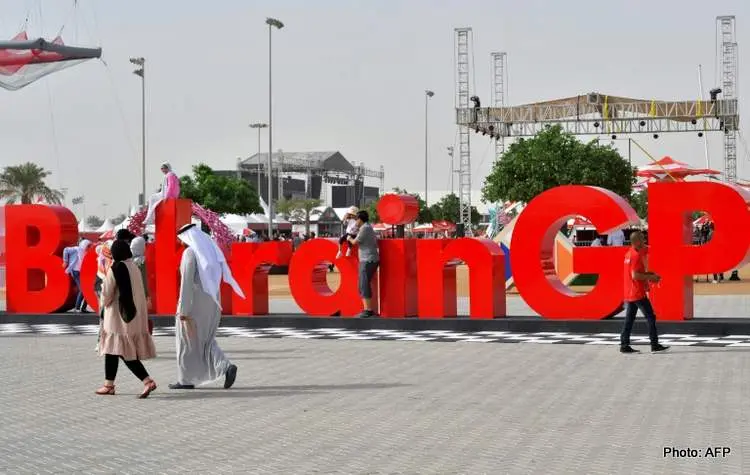
Amnesty International on Thursday accused Bahrain of using this weekend’s Formula 1 race to “sportwash” its image, amid an intense crackdown on political dissent in the Gulf island kingdom.
“Beneath the glamour of the F1, there is a far more sinister side to Bahrain, revealing the country as a deeply repressive state where anyone critical of the government can be jailed merely for posting a tweet,” said Amnesty’s Middle East director Samah Hadid.
“Instead of just ‘sportwashing’ its image and glossing over its dismal human rights record through high speed sport, the Bahraini government should immediately repeal laws that criminalise freedom of expression and fast track the release of all prisoners of conscience,” she said in a statement.
Bahrain, a key US ally located between rivals Saudi Arabia and Iran, has been gripped by bouts of unrest since 2011, when authorities cracked down on Shiite-led protests demanding political reform.
Hundreds of protesters have since been jailed or stripped of their nationality, including athletes.
Bahrain claims Iran trains and backs demonstrators in order to topple the Manama government. Iran denies the accusation.
Global rights groups have stepped up pressure on the tiny monarchy in the run-up to the Grand Prix.
More than a dozen global rights groups and trade unions, including Human Rights Watch and the International Trade Union Confederation, on Wednesday urged Formula 1 organisers to press the Bahraini government to release activists jailed for criticising the race.
Meanwhile, refugee footballer Hakeem al-Araibi has urged F1 fans to boycott this year's Grand Prix in Bahrain to protest human rights abuses, claiming he still feels threatened by authorities in his homeland.
The 25-year-old defender returned to Melbourne earlier this month after being detained during his honeymoon in Bangkok and threatened with extradition to his native Bahrain.
Bahraini authorities accuse him of offences linked to the 2011 Arab Spring uprisings. But his detention sparked a worldwide outcry and he was eventually allowed back to Australia, where he had been granted asylum.
Writing in The Guardian newspaper, al-Araibi repeated his claim that he was targeted for political reasons.
It follows his criticism of Asian Football Confederation president Sheikh Salman bin Ebrahim Al Khalifa, a member of Bahrain's ruling family.
"Evidently, it is a myth that sports and politics do not mix. Some people consider my release as a great victory. While I'm happy to be home, I cannot help but think that my personal fight is not over," he added.
"Even now, Bahrain has vowed to 'pursue all necessary legal actions' to drag me back to the place I fled. My brother remains imprisoned there, and I don't believe that I am safe from the Bahraini government."
Al-Araibi claimed authoritarian states were using sports events to raise their profile, "but when athletes and individuals call attention to this practice they are imprisoned and forcibly silenced".
He pointed to activist Najah Yousif, who human rights groups say was jailed for three years for criticising the kingdom's hosting of the 2017 Bahrain Grand Prix.
Prosecutors claimed she "broadcast false and biased news" about conditions in Bahrain and "promoted terrorist acts".
"Fans of Formula 1 racing need to help Najah. F1 needs to be told that human rights abuses cannot be tolerated. I urge you to boycott this year's Bahrain Grand Prix if Najah does not walk free before the Bahrain Grand Prix in March," said Al-Araibi.
He also called on major sporting bodies, including FIFA and the International Olympic Committee, to "step up" even further against injustice after both intervened to help his case.
"I believe they need to call for an investigation into the repression of athletes orchestrated by the (Bahraini) authorities in 2011. International sporting bodies, governments and individuals must unite to fight for the helpless," al-Araibi added.
He cited the case of jiujitsu fighter Mohamed Mirza, saying he was given an "unlawful" jail sentence and "subjected to brutal torture".
Rights groups have also claimed that athletes including footballers were tortured and abused during a crackdown on pro-democracy protests in Bahrain.
loading
Latest News

Loading