A brief history of the long tradition of team orders in F1
F1 NewsWednesday, 03 October 2018 at 10:36

Team orders in Formula 1 is not a new thing, in fact, it has been around since the early seasons of the modern era FIA run world championship in the fifties.
Most of the team orders delivered over the decades in Formula 1 - up and down the field - have probably never even been recorded as they did not affect the front runners or star drivers when they were dished out.
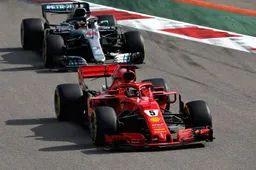
Team orders obliging drivers to cede the lead to their teammates - as Valtteri Bottas was ordered to do with Hamilton at the Russian Grand Prix - are few and far between, but incidents of holding station or ceding a position down the order and out of the spotlight have been plentiful over the course of the years.
Invariably when team orders are deployed the repercussions can split a team if not managed correctly.
Red Bull's hugely successful spell at the start of this decade was an example of two feuding drivers - Sebastian Vettel and Mark Webber - ignoring instructions from their pitwall.
Below is a list of some incidents of team order sagas that captured headlines when they happened:
- 1955: the Mercedes team asked Juan Manuel Fangio to let his teammate Stirling Moss win his home Grand Prix at Silverstone. Fangio obliged, refusing to attack Moss in the closing stages of the race and allowing the Englishman to take victory.
- 1956: Peter Collins, a title outsider, handed Fangio his Ferrari during the race after the Argentinian broke the steering on his car, with Collins' car Fangio went on to win the championship at the season finale Italian Grand Prix.
- 1964: A dramatic finale in which Ferrari driver Lorenzo Bandini moved over to John Surtees during the Mexican Grand Prix, allowing Surtees to get the necessary points to beat Graham Hill to the title.
- 1979: During the German Grand Prix Clay Regazzoni was instructed by the Williams pits not to attack his teammate Alan Jones for the lead, despite Regazzoni being faster at that point and ahead in the championship.
- 1981: Carlos Reutemann deliberately ignored Williams team orders at the 1981 Brazilian Grand Prix and did not allow Jones to pass, which resulted in a long feud between the two.
- 1982: René Arnoux enraged Renault by refusing to give way to his teammate Alain Prost at the French Grand Prix, who at the time was ahead in the championship
- 1983: During the South African Grand Prix, the Brabham team asked driver Riccardo Patrese to cede Nelson Piquet the race win if it ensured Piquet would win the driver's championship. However, this did not prove to be necessary as Patrese won the race while Piquet clinched a third place, sufficient to secure him the championship.
- 1992: Patrese blatantly waved his Williams teammate Nigel Mansell to get by him during the French Grand Prix.
- 1991: At the Japanese Grand Prix, Ayrton Senna was already world champion and handed victory to Gerhard Berger, saying after the race that he had given the first place to Berger because "he had been very helpful".
- 1997: At the European Grand Prix, Jacques Villeneuve, already with the title in the bag, was asked by his engineer via radio to let the McLaren cars pass as "They've been very helpful"
- 1998: McLaren drivers David Coulthard and Mika Häkkinen caused a stir by switching position at the end of the Australian Grand Prix, in order to respect a previous agreement.
- 1998: During the closing stages of the Belgian Grand Prix, the two Jordans of Damon Hill and Ralf Schumacher found themselves unexpectedly in the lead. Schumacher was subsequently ordered not to overtake Hill, to assure Jordan of a 1-2 finish.
- 1999: Mika Salo, driving for Ferrari in place of injured Michael Schumacher at the German Grand Prix, was leading the race when he was ordered to allow teammate Eddie Irvine to pass. Salo complied, giving up what would have been his only Formula 1 victory.
- 2002: Rubens Barrichello was ordered to allow Ferrari teammate Michael Schumacher to pass for the win at the Austrian Grand Prix. Jeered and booed by the crowd, Schumacher insisted that Barrichello take the winner's step on the podium.
- 2008: The Renault F1 team ordered Nelson Piquet to crash deliberately on the fourteenth lap of the Singapore Grand Prix to trigger a safety car and allow teammate Alonso to win the race. The scandal is now known as Crashgate.
- 2010: Mark Webber ordered to slow down when his Red Bull teammate Sebastian Vettel was closing in during the Turkish Grand Prix. Webber ignored the order, and the pair collided, each refusing to accept blame for the accident.
- 2010: During the German Grand Prix, Felipe Massa's race engineer Rob Smedley told his driver: "Fernando is faster than you. Can you confirm you understand that message?" Moments later, Massa eased back and allowed Alonso past.
- 2013: Red Bull driver Vettel was criticised for passing his team-mate Webber to win the Malaysian Grand Prix, going against "Multi-21", an order from his team to hold position.
- 2017: Mercedes team ordered Valtteri Bottas to yield his third position to Lewis Hamilton to attack second-placed Kimi Räikkönen during the Hungarian Grand Prix. When Hamilton was not able to get by Räikkönen, he gave back the position to Bottas.
- 2018: Mercedes order Bottas to cede the lead and thus victory to Hamilton at the Russian Grand Prix
The latest Mercedes use of team orders will not be the last in Formula 1, indeed most team chiefs and ex-drivers believe that as unpopular as they are, team orders will not go away as they are one of the sport's necessary evils.
loading
Latest News



Loading