The toughest race in the world - Dakar 2023 - starts on Saturday, with one of the most competitive fields ever witnessed for the event, in all classes.
This week, ahead of the 44th running old friends and rivals greeted each other, as the 2023 Dakar convoy and support crews descended on the Sea Camp that will serve as rally HQ for the build-up, documentation, technical checks, Thursday’s testing and the first two days of racing.
Over 450 vehicles including more than 70 cars, 125 motorcycles, 20 quads, 90 UTVs and 55 trucks, as well as over 100 classic regularity entries will take up the 2023 challenge.
Two days longer this year, the 45th Dakar commences with a short, sharp 11 km qualifying test coming Saturday 31 December. That sets the starting positions for the 4,700 km of racing and a total of 8,600 km to be driven over 15 days through to the 15 January finish.
Defending Dakar and World Rally Raid champions Toyota Gazoo Racing returns with a trio Hilux DKR T1+ headed by 2022 winners, Qatari Nasser Al-Attiyah and Mathieu Baumel. They’re backed by all-SA crews, 2009 Dakar winner and 2022 SA champion Giniel de Villiers and Dennis Murphy and young guns Henk Lategan and Brett Cummings.
Qatari legend Al-Attiyah aiming to make it five Dakar wins

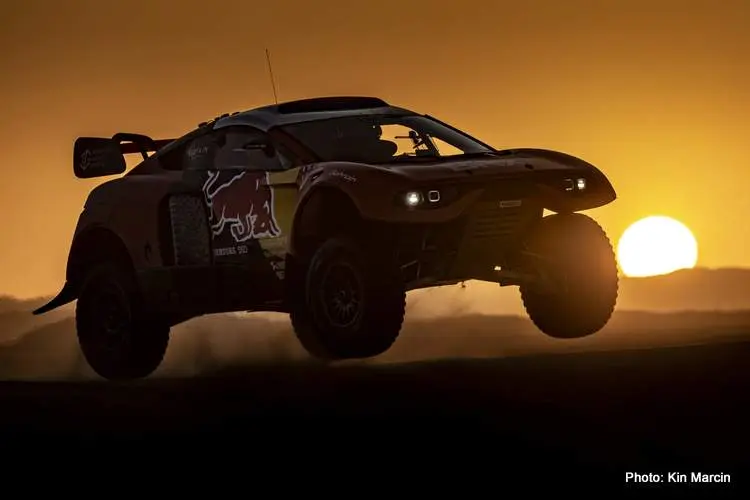
Of the other big guns, 9-time World Rally Champion Sebastien Loeb (pictured above) is chasing that elusive Dakar win alongside Fabian Lurquin alongside Argentine Orlando Terranova in the factory Prodrive Hunter alongside privateer Guerlain Chicherit and Zala Vaidotas.
Audi’s mighty petrol-electric hybrid Audi e-Tron Quattros can be expected to be a major Dakar factor in 2023 in Stéphane Peterhansel, Carlos Sainz Sr., and Mattias Ekstrom’s hands. Don’t ignore a powerful Mini line-up and Martin Prokop’s Ford Raptor among the car contenders.
Six factory teams are certain to peak two-wheeler interest. GasGas duo, 2022 Dakar winner Sam Sunderland and Daniel Sanders are a good bet, while sister brand KTM has former winners Toby Price, Matthias Walkner and Kevin Benavides in the saddle.
Add four factory Hondas - for Ricky Brabec, Adrien Van Beveren, Pablo Quintanilla and Jose Florimo alongside super privateer Joan Barreda - into the mix and it is anyone's race.
Wide open warfare among the two-wheel brigade

Husqvarna has Skyler Howes and Luciano Benavides backed by SA privateer and sand specialist Michael Docherty. Multiple SA champion, Botswana’s Kalahari Ferrari Ross Branch leads the Hero attack alongside Joaquim Rodriguez, Franco Caimi and Seb Bühler. Rui Gonçalves, Lorenzo Santolino and Harith Noah and Koitha Veettil ride for Sherco.
Moving on to the side-by-sides, 2022 winner Francisco Lopez Contardo joins Red Bull T3 juniors, lady star Cristina Guttieres, Gustavo Gugelmin and 2022 T4 winner Austin Jones in the SA-derived South Racing team. They take on Guillaume De Mevius, Helder Rodrigues and Ignacio Casale. South Africans Geoff Minnitt and Gerhard Snyman return alongside Dakar rookie crew SA Rally Raid T1 Class champions, Eben Basson and Abertus Pienaar.
Rokas Bakiuska starts as T4 favourite against Gerard Farres Guell, brothers Michal and Marek Goczal, Rodrigo De Oliveira and local hero Yasir Seaidan. Add lady racer Molly Taylor, bike refugee Xavier De Soultrait and Mozambican crew Paulo Oliveira and Miguel Alberty. Stefan Svitko, Alexandre Giroud, Manuel Andujar, Pablo Copetti. Giovanni Enrico and Kamil Wisniewski and Laisvydas Kancius will meanwhile continue their eternal Dakar Quad battle.
Dakar starts with a short Prologue ahead of Sunday's mega gravel loop

Dakar’s trucks should crown a new winner in the absence of the Russian Kamaz in 2023. Kees Koolen, Martin Macik, David Svanda and Vaidotas Paskevicius fly the Iveco flag. MAN driver Gerrit Zuurmond, Ales Loprais’ Praga, Omir Martinec in a Renault and Teruhito Sugawara’s Hino are among those out to stop them.
Dakar commences with Saturday’s 11 km Prologue before Sunday’s full 367 km gravel loop with the first dune challenge toward the finish. A tough first week follows with 430 km through the boulder fields to Alula on Monday, 447 km to Ha'il on Tuesday and 425 and 373 km loops through the canyons and dunes around there on Wednesday and Thursday.
Friday is 467 km of dune plateaus to Al Duwadimi, Saturday’s 472 km longest stage of rocks and dunes, and Sunday’s new 398 km run lead to Riyadh for Rest Day Monday.
Then it’s 358 km to Haradh, and a tough 113 km to Shaybah. 273 km on Thursday and Friday’s 185 km comprise the no-service Empty Quarter Marathon, before 154 km to Al-Hofuf, and a nerve-wracking 136 km on the beach to Sunday 15 January’s Dammam finish.
(Dakar reports by Motorsport Media courtesy of Toyota Gazoo Racing)

About the Dakar Rally
- The Dakar Rally is the pinnacle of the Rally Raid calendar. Rally raid, also known as cross-country rallying, is a form of long-distance off-road racing that takes place over several days.
- The Dakar Rally adventure has its origins in 1977 when French motorcycle racer Thierry Sabine got lost on his motorbike in the Libyan desert during the Abidjan-Nice Rally. After navigating his way out of the desert, the Frenchman was determined to design a race that drew on his experience with a route starting in Europe, continuing to Algiers and crossing Agadez before eventually finishing at Dakar. Since that time, the Dakar Rally has evolved from racing in Africa to South America and now to Saudi Arabia.
- The race consists of one stage per day comprising at least one "special" stage each (several hundred kilometres long), which may be on or off-road. The total distance covered is several thousand kilometres. The event takes place over a period of ten to fifteen days.
- The classification of the stage is made up of the times set in the special stage plus any sporting penalties. The race requires precise navigation, which is done via a roadbook provided by the organisers and handed out at the start of each stage.
- The starting order of each special will be based on the times set in the timed sector of the previous stage, including any sporting penalties (e.g. for speeding in link sectors or missing waypoints) incurred during the stage.
- The 2023 Dakar Rally will be the longest route since 2014 participants will tackle 5,000 kilometres of specials into a prologue and 14 stages. The Prologue Stage launches on December 31, 2022, in Yanbu by the Red Sea with the field looking to make it all the way across - loaded with more dunes and potential pitfalls than ever before - to Dammam on the Arabian Gulf for a January 15 finish. (Source: Red Bull)
Latest News
Loading