Formula 1 has produced more than seven decades of elite competition, and yet one question never loses its edge: who is the best racer in the world?
Champions have come and gone, records have been rewritten, and the sport itself has changed almost beyond recognition since the first World Championship in 1950. Still, comparisons endure — and they matter, not just to historians and journalists, but to the millions of fans who follow every race, debate every qualifying session, and place wagers on race outcomes through.
Those who use their betway login to access F1 markets will find odds that shift in real time alongside driver form, team performance, and even weather forecasts — turning the ancient debate over who is truly the greatest into something with very immediate, very tangible stakes.
This article does not offer a definitive verdict — no honest analysis can. What it does offer is a structured, evidence-based look at the drivers who most consistently redefined what was possible behind the wheel of a Formula 1 car.
The criteria include championship titles, win percentage, performance relative to teammates, the competitive quality of the machinery available, and the circumstances of each career.
The Criteria: What Makes a Driver Truly Great?

Raw statistics — championships won, pole positions, fastest laps — tell part of the story. But context matters enormously in Formula 1. A driver in a dominant car during a weak era and a driver extracting the maximum from an uncompetitive machine occupy very different positions in the historical record.
The best formula 1 drivers of all time are typically evaluated across several dimensions: pace relative to teammates (the most controlled comparison available), performance in wet or adverse conditions, strategic racecraft, psychological resilience under pressure, and the ability to elevate a team beyond its apparent ceiling.
F1 betting odds provide one modern proxy for perceived dominance — when a single driver commands overwhelming pre-season favouritism year after year, as Hamilton did through the late 2010s and Verstappen does now, it reflects a broad consensus among analysts and markets that the gap in class is measurable.
Top 10 F1 Drivers: Career Statistics at a Glance
| Driver | Active Years | Championships | Wins | Poles | Win Rate |
| Lewis Hamilton | 2007–present | 7 | 105 | 104 | ~34% |
| Michael Schumacher | 1991–2012 | 7 | 91 | 68 | ~30% |
| Ayrton Senna | 1984–1994 | 3 | 41 | 65 | ~25% |
| Alain Prost | 1980–1993 | 4 | 51 | 33 | ~24% |
| Sebastian Vettel | 2007–2022 | 4 | 53 | 57 | ~29% |
| Max Verstappen | 2015–present | 4 | 63+ | 40+ | ~39% |
| Niki Lauda | 1971–1985 | 2 | 25 | 24 | ~17% |
| Jim Clark | 1960–1968 | 2 | 25 | 33 | ~34% |
| Juan Manuel Fangio | 1950–1958 | 5 | 24 | 29 | ~47% |
| Jackie Stewart | 1965–1973 | 3 | 27 | 17 | ~23% |
| Driver | Decades Active | Championships | Adjusted Rate | ||
| Fangio | 1 (1950s) | 5 | High | ||
| Clark | 1 (1960s) | 2 | High (career cut short) | ||
| Schumacher | 2 (1990s–2000s) | 7 | Very High | ||
| Hamilton | 2 (2000s–2020s) | 7 | Very High | ||
| Verstappen | 1+ (2020s) | 4 | Exceptionally High (ongoing) |
Statistics current as of early 2026. Verstappen's figures continue to evolve.
Lewis Hamilton: The Statistical Record-Holder

No discussion of the best f1 drivers all time begins anywhere other than Lewis Hamilton. The British driver holds the all-time records for race wins (105), pole positions (104), and career points. He claimed seven World Championships — matching Michael Schumacher's long-standing record — in machinery that was frequently the class of the field, but always with a level of execution that left little doubt about his personal contribution.
Hamilton's 2020 title, secured in a season shortened by the pandemic, saw him win 11 of 16 races. His 2008 championship, his first, came in far less dominant circumstances and required a last-corner pass on the final lap of the final race to seal it. That combination of adaptability — thriving in different eras, with different engineers, under different pressure — is a hallmark of true greatness.
F1 betting markets consistently installed Hamilton as the championship favourite from 2014 through 2020, reflecting not just the strength of the Mercedes car but the degree to which the market trusted him to convert that advantage. His influence on f1 betting odds during that period was arguably as significant as any driver in the sport's history.
Michael Schumacher: The Man Who Rewrote the Record Books

Before Hamilton arrived, Michael Schumacher was the answer to every "best formula 1 driver" debate. The German driver won five consecutive World Championships between 2000 and 2004 with Ferrari — a sequence of dominance that had no modern precedent. His 91 race wins stood as the record until 2020.
What separates Schumacher in the historical record is his role not just as a formula 1 racer but as an architect of team performance. He rebuilt Ferrari from a struggling constructor in the mid-1990s into the most successful team of the early 2000s. His technical feedback, physical preparation, and competitive intensity reshaped how Formula 1 teams approached driver development.
His record also invites scrutiny. Several of his most controversial moments — notably his collision with Damon Hill in 1994 and the Jerez incident with Jacques Villeneuve in 1997 — remain part of the historical debate about where competitive edge ends and unsportsmanlike conduct begins. These episodes do not erase his achievements, but they remain relevant to any complete assessment.
Ayrton Senna: Mythology and Measurable Genius

Ayrton Senna occupies a unique place among f1 legends — part because of what he achieved, and in equal part because of the manner in which he was taken from the sport at Imola in May 1994. Had he survived and continued racing, the statistical picture might look very different. But even as it stands, Senna's record is extraordinary.
Three championships, 41 wins, and 65 pole positions in a career spanning ten seasons tell only a fraction of the story. His qualifying pace was, by most analyses, the finest the sport has seen. At Monaco, where precision and commitment define everything, he won six times. In the rain — conditions that strip away car performance advantages and expose pure driver skill — he was in a category of his own.
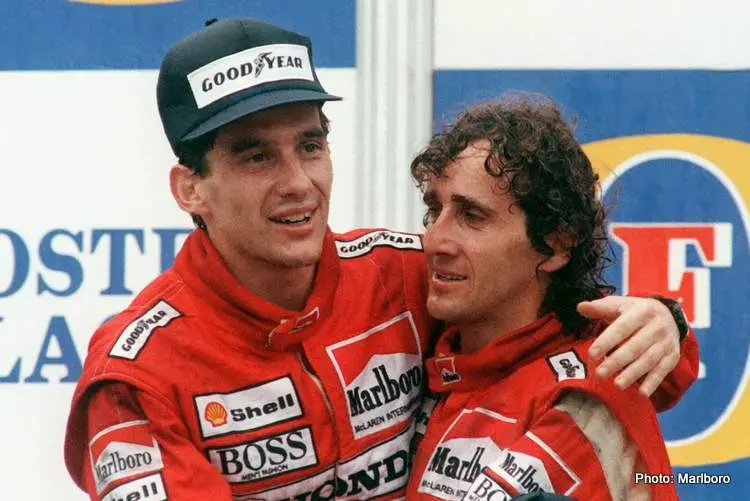
Senna's rivalry with Alain Prost remains the most studied driver relationship in the sport's history. Their battles at McLaren from 1988 to 1989 produced some of the fastest, most entertaining, and most contentious racing Formula 1 has ever seen. For fans who place wagers on F1 head-to-head markets, this pairing represents the kind of matched-but-distinct talent that makes driver-versus-driver comparisons so compelling.
Alain Prost: The Professor of Racing

Alain Prost won four World Championships using a method almost diametrically opposed to Senna's. Where Senna sought perfection through instinct and commitment, Prost calculated — managing tyres, fuel, and risk with a precision that earned him the nickname "The Professor." His approach was frequently mischaracterised as conservative. In reality, it was ruthlessly efficient.
Prost's win rate of roughly 24% across 199 starts reflects a driver who competed deep into the sport's most competitive eras and continued winning. His fourth title, claimed in 1993 with Williams, came after a year away from the sport — demonstrating a level of professional longevity that few can match.
As a best formula 1 driver contender, the debate centres not on talent but on philosophy: whether a driver who minimised unnecessary risk deserves the same credit as one who maximised pure pace.
Juan Manuel Fangio: The Greatest Win Rate in F1 History

Any serious list of the best f1 driver ever candidates must confront Juan Manuel Fangio. The Argentine competed in just 51 World Championship races between 1950 and 1958, but his win rate of approximately 47% — 24 victories from 51 starts — has never been approached by any driver in the sport's history.
Fangio won five World Championships across four different constructors: Alfa Romeo, Ferrari, Maserati, and Mercedes. Switching teams and machinery with such regularity while maintaining absolute dominance speaks to an adaptability that transcends the equipment. His win at the 1957 German Grand Prix at the Nürburgring, in which he overcame a 48-second deficit after a slow pit stop to win by a narrow margin, is still widely cited as the greatest individual drive in F1 history.
The challenge in assessing Fangio against the modern era is the nature of the competition and the limited field sizes. He raced in a period when the entry lists were smaller and the professional infrastructure of today did not exist. None of this diminishes what he did — it simply requires honest contextualisation.
Sebastian Vettel: Four Titles and a Legacy Still Being Written

Sebastian Vettel was, for four consecutive seasons between 2010 and 2013, the best driver in the world by any measurable standard. His four championships with Red Bull came in increasingly dominant fashion, culminating in a 2013 season in which he won nine consecutive races — a record that still stands.
Vettel's precision in qualifying and his ability to manage a race from the front were exceptional. His period at Ferrari from 2015 to 2020 was less successful in championship terms, but it showed a different dimension of his career: a driver striving to add emotional weight to his legacy, drawn by the romance of winning with the famous Prancing Horse.
Among fans engaged with f1 betting strategies, Vettel's Red Bull era offers an interesting historical case study — a driver whose dominance was so complete that the betting markets struggled to price in realistic opposition.
Max Verstappen: Redefining the Modern Standard

Max Verstappen entered Formula 1 in 2015 at the age of 17 and immediately announced himself as a talent of rare quality. By 2021, he had won his first World Championship in the most contested title battle the sport had seen in a decade. By 2026, he holds four consecutive titles and a win rate approaching 39% — figures that place him firmly among the best f1 drivers all time even before his career has reached its midpoint.
What distinguishes Verstappen is not just speed but composure. His ability to manage pressure, adapt to radically different car characteristics across regulatory changes, and extract performance on the absolute limit without overstepping it, identifies him as the elite formula 1 racer of his generation.
His presence has transformed f1 betting odds structures. In 2023, Verstappen's championship price at the start of the season was the shortest in modern records — a reflection of the breadth of analytical consensus around his ability. Fans who follow f1 betting have increasingly used Verstappen's dominance as a reference point for understanding value in longer-odds alternatives.
Niki Lauda: Courage and Calculation

Niki Lauda's place among f1 legends is secured by both his driving and his character. Two World Championships (1975, 1977) and a near-miss in 1976 — a season that remains the most dramatic in the sport's history — represent remarkable achievement in an era when racing carried genuine life-threatening risk.
Lauda survived a near-fatal crash at the Nürburgring in 1976 with burns covering much of his face and permanent damage to his lungs. Six weeks later, he returned to the cockpit. He finished the season second in the championship by a single point, losing narrowly to James Hunt. His 1977 title, secured with precision and calculation, remains one of the sport's most stoic achievements.
Beyond his racing record, Lauda's influence as a team advisor and aviation entrepreneur demonstrated that his analytical mind extended well beyond the cockpit. Few figures in the sport are as genuinely respected across all dimensions.
Jim Clark: The Natural

Jim Clark belongs to a category reserved for perhaps three or four drivers across the sport's entire history: those who appeared to operate at a level so far beyond their contemporaries that contemporaries themselves acknowledged it without reservation.
The Scottish driver won two World Championships (1963, 1965), took 25 wins from 72 starts, and was killed in a Formula 2 race at Hockenheim in 1968 — before his career was anywhere near its natural conclusion.
Clark's win rate of approximately 34% is matched only by Hamilton and approached by Fangio. His mastery of different car types — Formula 1, Indianapolis 500, Formula 2, touring cars — places him among the most complete drivers in motor racing history, not merely in Formula 1 specifically.
Jackie Stewart: Safety, Speed, and Substance

Jackie Stewart won three World Championships between 1969 and 1973 while simultaneously campaigning, at considerable personal and professional cost, for improved safety standards in Formula 1. Several of his closest friends and rivals died during his racing career, and he chose to retire on his own terms rather than risk the same fate.
Stewart's 27 wins from 99 starts represented a remarkable strike rate for his era. His advocacy for safety barriers, medical facilities, and driver protections transformed the sport — changes that many subsequent drivers, who never knew the consequences of their absence, benefited from without full awareness of the cost.
Expert Insight: Analyst note: When evaluating the best racer in the world across different eras, one of the most reliable methods is to compare each driver's performance against teammates in equal machinery. This approach controls for car advantage. Senna outperformed every teammate he ever had. Schumacher was rarely matched within his own team.
Hamilton's performance against Nico Rosberg, Valtteri Bottas, and George Russell — all strong drivers — showed consistent margins in his favour. By this metric, the gap between the top five in this list and the rest of the field narrows considerably, making era-adjusted comparisons more legitimate than raw championship counts alone.
The Betting Dimension: How Markets Reflect Driver Value

F1 betting has grown significantly as a fan engagement tool, particularly since the sport's popularity expanded through documentary coverage and social media. Championship markets, race winner markets, and head-to-head driver comparisons have become mainstream products, and the odds generated by these markets offer an interesting parallel data stream to traditional statistical analysis.
Historically, extended periods of single-driver dominance tend to compress f1 betting odds in the championship market, reducing the commercial interest for casual bettors while creating value opportunities in second- and third-place markets. During Schumacher's five-title run, Ferrari's dominance made the championship market largely uncompetitive. During Verstappen's current era, similar dynamics apply.
F1 betting strategies used by more systematic bettors often focus not on championship markets but on race-by-race variance — pit stop timing, safety car deployment, weather changes — where individual driver skill intersects with team strategy in ways that create pricing inefficiencies. Understanding the historical records of elite drivers in variable conditions (Senna, Hamilton, and Verstappen have all shown premium wet-weather performance) can inform how those inefficiencies are identified.
Era-Adjusted Comparison: Championships Per Decade Active
| Driver | Active Years | Championships | Wins | Poles | Win Rate |
| Lewis Hamilton | 2007–present | 7 | 105 | 104 | ~34% |
| Michael Schumacher | 1991–2012 | 7 | 91 | 68 | ~30% |
| Ayrton Senna | 1984–1994 | 3 | 41 | 65 | ~25% |
| Alain Prost | 1980–1993 | 4 | 51 | 33 | ~24% |
| Sebastian Vettel | 2007–2022 | 4 | 53 | 57 | ~29% |
| Max Verstappen | 2015–present | 4 | 63+ | 40+ | ~39% |
| Niki Lauda | 1971–1985 | 2 | 25 | 24 | ~17% |
| Jim Clark | 1960–1968 | 2 | 25 | 33 | ~34% |
| Juan Manuel Fangio | 1950–1958 | 5 | 24 | 29 | ~47% |
| Jackie Stewart | 1965–1973 | 3 | 27 | 17 | ~23% |
| Driver | Decades Active | Championships | Adjusted Rate | ||
| Fangio | 1 (1950s) | 5 | High | ||
| Clark | 1 (1960s) | 2 | High (career cut short) | ||
| Schumacher | 2 (1990s–2000s) | 7 | Very High | ||
| Hamilton | 2 (2000s–2020s) | 7 | Very High | ||
| Verstappen | 1+ (2020s) | 4 | Exceptionally High (ongoing) |
Expert Insight: Racing historian's perspective: The question "who is the best f1 driver ever?" is ultimately unanswerable in a purely objective sense, because no two drivers competed in the same conditions, in the same era, against the same quality of opposition.
What analysis can do is identify the drivers who most consistently outperformed reasonable expectations — those who won more than their machinery alone would predict. By that standard, Fangio, Senna, Hamilton, and Verstappen stand at the very top of the historical hierarchy, each from a different era, each having redefined what was considered possible.
The top 10 f1 drivers in history share a quality that statistics can gesture toward but never fully capture: the ability to raise the performance level of everything around them. The best formula 1 drivers of all time were not merely fast. They were transformative — for their teams, for the technical development of the cars, and for the fans who followed them.
Whether the best driver in the world is Hamilton, Fangio, Senna, or Verstappen depends on the weight assigned to different criteria, different eras, and different values. What is not in doubt is that Formula 1 has produced, across its seventy-five-year history, a group of exceptional individuals whose combined record represents one of the most compelling competitive chronicles in all of sport.
Latest News

Loading