When Watkins Glen collapsed under financial strain in 1980, Formula 1 needed a new American home that could actually pay its bills.
Bernie Ecclestone’s Formula One Constructors Association (FOCA) wanted television-friendly time zones, big money sanction fees and a glamorous backdrop. Caesars Palace offered all three. Formula 1 was heading to Las Vegas.
For the casino, the 1981 Formula 1 World Championship finale was a global shop window. The resort already hosted title fights in the boxing ring. Putting the fastest cars in the world in its backyard would signal that Las Vegas was more than smoky tables and slot machines.
Caesars executive Bill Weinberger and Ecclestone reportedly sketched out a circuit on a placemat, proving that a full Grand Prix layout could be squeezed into the vast parking lot behind the hotel. Engineers carved out a flat two-mile course between concrete walls and fences, wrapped entirely around the service areas of the resort.
On paper it was a purpose-built temporary circuit, a Monaco in the desert. In reality drivers arrived in October 1981, looked at the featureless expanse of tarmac, the high fences and the blazing heat, and quickly dubbed it a car park Grand Prix.
Politics, money and mob shadows
The Caesars Palace Grand Prix came at the end of the bitter FISA versus FOCA power struggle that had defined the early eighties. Ecclestone’s FOCA teams wanted commercial control and maximum appearance money. Jean Marie Balestre’s governing body wanted regulatory control and a calendar that suited manufacturers and broadcasters.
Las Vegas suited Ecclestone perfectly. The race fee was high, the television pictures were spectacular enough, and the deal was done with a single promoter that controlled its own land. Beneath that neat structure lay the city’s murkier history.
The Strip that welcomed Formula 1 had been built on Teamsters pension money and mob-connected operators. Historians and the Mob Museum in Las Vegas have since traced how figures linked to Meyer Lansky and other crime families sat close to the money at several major resorts.
Author Randall Cannon, who studied the Caesars Palace Grand Prix in detail, describes an “unholy alliance” of gambling capital, organised crime legacy and the hard-headed commercialism of a sport that was rapidly centralising power in Ecclestone’s hands.
There is no suggestion the race itself was fixed. The shenanigans were financial and political, a casino using Formula 1 to launder its image in the eyes of the world, while the sport happily banked the cheque and looked the other way.
The 1981 Caesars Palace Grand Prix, a title in a car park

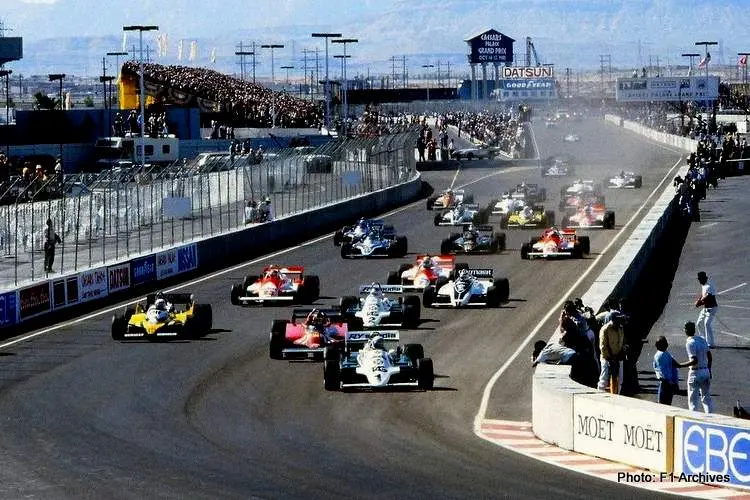
Sporting drama saved the event. The first Caesars Palace Grand Prix on 17 October 1981 was the final round of a tense season. Three drivers arrived with a chance of the World Championship. Carlos Reutemann led with 49 points for Williams, Nelson Piquet had 48 for Brabham and Jacques Laffite sat on 43 for Ligier with only an outside shot.
Reutemann took pole position with the Williams FW07, team mate Alan Jones alongside him. The relationship between the two was toxic after the famous Rio team orders row. Behind them Piquet lined up fourth, needing to beat Reutemann and finish high enough to cover any late charge from Laffite.
The new anti-clockwise circuit loaded neck muscles heavily in the Nevada heat. Surface grip was inconsistent, sight lines were poor and the walls were close. Drivers hated it, but they had to race.
At the start Jones jumped Reutemann and never looked back, signing off his Formula 1 career with a dominant final win. Reutemann’s gearbox began to fail almost immediately. He sank through the field, powerless to defend his title lead. Piquet, suffering in the heat and physically exhausted, slid backward at times but clung on to fifth place.
Aftermath, cold numbers and a cold city

When the chequered flag fell, the mathematics were brutal. Jones won from Alain Prost and Bruno Giacomelli. Piquet’s two points for fifth took him to 50, Reutemann stayed on 49. The title went to Brabham by a single point, decided in a casino parking lot.
On track the first Las Vegas Grand Prix delivered exactly what Ecclestone and Caesars Palace had paid for, live pictures of a title decider from a glittering American location. Off track the numbers did not add up. Building and operating the temporary circuit was expensive.
The layout wound behind the hotel rather than on the Strip, which meant that other casinos saw little benefit and plenty of disruption. Local enthusiasm was modest. Many grandstand seats were filled by casino guests and corporate invitations rather than paying fans.
Drivers savaged the circuit. Some called it one of the worst they had seen, an anonymous maze of ninety-degree corners. The flat concrete surroundings sapped atmosphere and confused braking markers. The anti-clockwise direction shredded neck muscles and left several drivers close to collapse in the closing laps.
The novelty of Formula 1 could not disguise the sense that this was a made-for-television event imposed on a city that had not asked for it.
Formula 1 returned to Las Vegas in 1982, again at Caesars Palace, but that's a story for tomorrow.
Latest News
Loading