F1's first Constructors Champions: Tony Vandervell's Vanwall team
F1 NewsSaturday, 11 October 2025 at 07:30
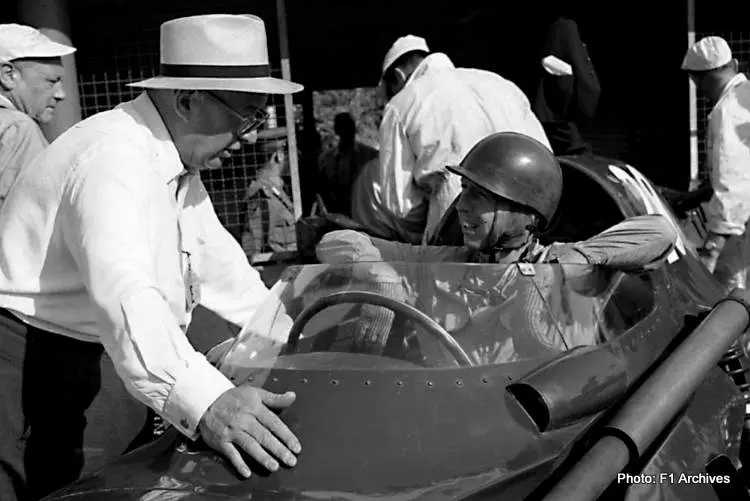
In the wake of McLaren wrapping up the 2025 Formula 1 Constructors' World Championship at the Singapore Grand Prix, it is a fitting time to look back on the first team to claim that accolade in the top flight... just beating Ferrari to it!
Although Formula 1 has been governed by the FIA since 1950, the year of the first World Championship, it was only in 1958 that the Constructors' title was added as a reward for teams.
And the first Formula 1 Constructors' Champions was Vanwall, a team founded, owned and run by Tony Vandervell. When he set out to conquer the pinnacle of the sport, he was not just taking on Ferrari and Maserati. He was trying to prove that Britain could build a car fast enough, tough enough, and clever enough to beat the best of Italy. The result?
Vanwall, a name that would write itself into motorsport history by winning the first-ever Formula 1 Constructors' Championship but it was a triumph forged from frustration, fuelled by obsession, and ultimately cut short by tragedy.
By all accounts, Tony Vandervell was not a dreamer. He was a wealthy, hard-nosed British industrialist who turned bearings into big business and wanted racing to be treated the same way, seriously. Born in 1898 and trained in engineering, Vandervell took over his father’s company, CAV, and made a fortune with his own business, Vandervell Products, producing Thinwall bearings that powered everything from military tanks to Rolls-Royce engines.
Vandervell had another love: motorsport

In the 1920s, he raced motorcycles and cars at Brooklands. And in the 1940s, he put his money behind BRM’s V16 project, only to grow increasingly frustrated with what he called committee racing. He wanted no bureaucracy, no dithering. He wanted to win. So he did what men like him do. He started his own team.
As Stirling Moss once recalled: "Vandervell was a tough old bugger, but you never doubted his commitment. He was in it to beat the bloody Italians, plain and simple."
Vandervell’s first attempt came not with his own car, but by buying Ferraris and modifying them with his Thinwall bearings. These “Thinwall Specials” were both a rolling advertisement and a learning curve. They taught Vandervell and his team crucial lessons about chassis balance, powertrain durability, and aerodynamic packaging. The goal was clear: to learn enough to build a fully British Grand Prix car.
In 1954, Vanwall made its World Championship debut at the British Grand Prix with a car designed by Owen Maddock of Cooper and powered by a 2.0-litre engine that had been developed in-house using Norton motorcycle technology as its foundation. The chassis was crude, but the ambition was world-class. The green Vanwalls were patriotic machines, fast in a straight line but fragile and often unreliable.
Over the next two years, Vanwall grew rapidly. Vandervell hired aerodynamicist Frank Costin and chassis engineer Colin Chapman, giving the car a revolutionary low-drag shape and improved handling. The team also upgraded to a 2.5-litre four-cylinder engine, producing around 285 horsepower, developed in collaboration with Harry Weslake and fuel injection specialist Bosch.
1956 to 1957: Gaining momentum

In 1956, Vanwall made a strategic leap by signing Stirling Moss, who shared his drives between Maserati and Vanwall that season. While Vanwall was not yet a regular threat, the team began to turn heads. The car showed flashes of pace, and with drivers like Harry Schell and Maurice Trintignant in the fold, Vanwall started building consistency.
The breakthrough came in 1957. At the British Grand Prix at Aintree, Stirling Moss and Tony Brooks famously shared victory in a Vanwall. Brooks had started the race but was feeling unwell, so Moss took over mid-race and brought the car home to win. It was the first time a British-built car had won a World Championship Grand Prix, and the roar of the crowd said it all. Britain had arrived.
That year, Vanwall also took wins in Italy and at the Pescara Grand Prix, with Moss in sublime form. The car was fast, stable, and finally reliable enough to take on the Ferraris and Maseratis over a full race distance. The success was not just technical but symbolic. Vanwall had proven a British team could out-engineer and out-race the Continentals.
The high-water mark: 1958

If 1957 laid the foundation, 1958 was the Vanwall masterstroke. With a driver lineup featuring Moss, Tony Brooks, and Stuart Lewis-Evans, the team was well-balanced, competitive, and professionally run. Moss won three Grands Prix (Netherlands, Portugal, and Morocco), while Brooks took three of his own (Belgium, Germany, and Italy). In total, Vanwall won six of the ten races that counted toward the World Championship.
This collective brilliance earned Vanwall the inaugural Constructors' Championship, a new title introduced by the FIA to recognise the engineering side of the competition. While Moss missed out on the Drivers' Championship by a single point to Ferrari's Mike Hawthorn, the significance of Vanwall’s title was historic. For the first time, a British team had beaten Ferrari across a season.
The Vanwall was a genuinely innovative car. It featured disc brakes, fuel injection, and advanced streamlining. And it had three drivers who brought different strengths. Moss, the star, brought outright speed and tactical intelligence. Brooks, a smooth and fearless racer, was perhaps the most underrated driver of his era. Lewis-Evans, the youngster, showed great promise and had a superb technical feel.
But the year was not without heartbreak. In the final race in Morocco, Stuart Lewis-Evans suffered a fiery crash that led to fatal burns. He died six days later. Vandervell, already battling health issues, was devastated. He had treated Lewis-Evans almost like a son and had personally backed his career.
After Morocco: The decline begins

The loss of Lewis-Evans took a heavy toll on Vandervell. He was never quite the same. The joy of beating Ferrari had been eclipsed by the pain of seeing one of his drivers perish.
Vandervell quietly withdrew from Formula One at the start of 1959, selling off much of the team’s infrastructure. Without his leadership and financial support, Vanwall rapidly lost direction.
The team fielded cars sporadically until 1961 but failed to register another win. A rear-engined Vanwall was built for the short-lived Intercontinental Formula in 1962, driven by future world champion John Surtees. While it showed potential, the series collapsed quickly, and Vanwall was no longer a name of competitive consequence.
Tony Vandervell passed away in 1967. His name had largely faded from public memory, eclipsed by the likes of Lotus, Cooper, and BRM. But his role in reshaping the sport, in setting a benchmark for British excellence, should never be forgotten.
The Drivers: Moss, Brooks, and Lewis-Evans

Stirling Moss may never have won a world title, but his legacy is unmatched. In a Vanwall, he was often untouchable. His 1958 drive in Portugal, where he stopped mid-race to defend Mike Hawthorn’s disqualification (thus saving Hawthorn’s points and costing himself the title), remains one of the sport’s most honourable moments.
Moss’s respect for Vandervell was deep. He admired the boss’s tenacity and shared his hatred of losing.
Tony Brooks was more reserved but no less formidable. He had a reputation for mechanical sympathy, rarely overdriving the car, and delivering results under pressure. His win at the 1958 German Grand Prix on the fearsome Nürburgring was a masterclass in finesse and control.
Stuart Lewis-Evans was seen by many as a future champion. He had been mentored by Moss and was known for his bravery and commitment. His death was not only a blow to Vanwall, but to British motorsport, which had lost a future hero.
Thoughts on Vandervell

Tony Brooks, Vanwall Driver (1956–1958): “Tony Vandervell was the kind of man who got things done. There were no committees, no nonsense. If something needed doing, it got done.”
Stirling Moss on Vanwall’s 1957 British Grand Prix victory: “Winning with Vanwall at Aintree was one of the great moments. We proved that British engineering could take on and beat the best. That win was a turning point.”
John Surtees drove the rear-engined Vanwall in 1962: “The Vanwall was ahead of its time in many ways. It had real potential, and you could tell the team had once been on top of the world. It just lacked the backing by then.”
Frank Costin, Aerodynamicist: “The car didn’t just look good, it cut through the air better than anything else on the grid. Vandervell wanted nothing less than the best and pushed everyone to deliver it.”
Vanwall in Formula 1 by the numbers
- Active Years: 1954 to 1961
- Constructors' Championships: 1 (1958)
- Drivers' Championships: 0 (Moss finished runner-up in 1958)
- Grands Prix Entered: 29
- Wins: 9
- Podiums: 13
- Pole Positions: 7
- Fastest Laps: 6
- Total Points: 57
Legacy: Vanwall's quiet revolution

Vanwall was not a long-lasting team, but its impact was seismic. It was born from British industry, burned bright with brilliance, and vanished in sorrow. Yet that single green car in 1958 made an entire nation believe in its motorsport future. Vandervell set a standard that Lotus, BRM, McLaren, and Williams would later follow.
Tony Vandervell deserves to be remembered not just as a constructor, but as a revolutionary. He changed the way British teams approached Formula 1. He funded his own vision, hired the best engineers, trusted top drivers, and fought with relentless ambition.
For one unforgettable season, Vanwall was the best team in the world. And for that, it will always be a name etched in the foundations of Formula 1.
Latest News

Loading