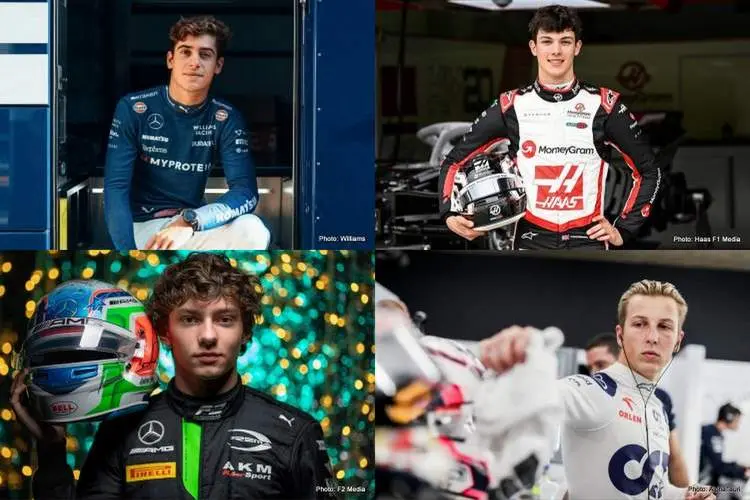
Last week, Parc Ferme talked about the new wave of young Formula 2 drivers arriving in Formula 1. This week it looks at why they are unnerving their more experienced teammates.
There’s no doubt that every time an F2 graduate has stepped into an F1 car recently, they have mightily impressed. Even Mercedes’ Kimi Antonelli was quick while he circulated.
Meanwhile, the others have generally kicked in the door and delivered beyond expectations. This has made a few teammate Gods seem, well, a little more mortal.
The reason for this surprising phenomenon is not down to one factor, of course. There are a number of areas that appear to be raising the bar for the next generation.
Heads I win, tails, you’re gone
There’s nothing more performance-enhancing than climbing into an F1 car knowing you have nothing to lose. If you’re five tenths off the regular incumbent, then yeah, you’re new. If you match or beat them, boom, you’re the next F1 rock star!
The universe demands balance though, which means the counter side to this equation lies with the guy on the sidelines. They have a little voice in their heads that whispers: "Hey, what if he matches or is even faster?"
This is enough on its own to make it a self-fulfilling prophecy.
Better muscle memory
Those who do racetrack driving experiences often ask how an F1 driver maintains this cognitive juggling act for two hours. The short answer is they don’t.
They’re not thinking about the same things as “Billy”. The motor actions for brake application, changing gear, turning in, etc. require no cognitive input; it's all instinct.
Conventional wisdom says it takes ten thousand repetitions, or was it hours, to develop this kind of unconscious reflex action. However, this is only half the story.
Strong memory models
Without delving too deeply into neuroscience, memory models are a 3D construct created by the brain that enable us to perceive the world. Amongst other things, it predicts the speed and direction of objects. Without this ability, we would never survive.
At this point, it is easier to think of this generically as “experience”. The more refined the memory model, the more accurately we can predict the future, i.e., the better the model, the closer you can go to the edge. Some people have a genetic head start from the outset, often referred to as good hand eye coordination.
However, there is no need to explain further how the precision of these models impacts a driver’s performance.
We live in a simulation

Thirty years ago, you needed to be racing karts at the age of ten to build the required muscle memory and models for F1. Then the start point became five years old.
Now it’s all of this plus constant work in the motorhome simulator and a team of engineers “spannering” the kart. The hours of racing experience – real or virtual have grown exponentially in the last ten years.
It’s tough out there
These factors have combined to make the kart racing environment uber competitive. It has also sadly made it financially prohibitive for the average Bank of Dad.
However, the derived race and driving experience is greater. In turn, every tier of progression becomes more and more competitive as only those with either the talent and/or money climb further up the greasy pole.
Mental plasticity
The F2 noob is open to all things and naturally more adaptable. F1 cars and the regulations are constantly being developed, and the pace of change is accelerating.
Skills that were gold yesterday are lead tomorrow. New entrants ask: "What do I need to do differently to make the car quicker?"
Older drivers: "What needs to be changed on the car to make me quicker?"
While both have a place, the latter can end up nullifying what should have been a positive development step forward. The good news is that plasticity is possible at any age.
However, first we need to do it. The old hubris attitude of “I’m an F1 driver, so my driving style is unassailable” is redundant. Adapt, improvise, overcome, or leave…
Latest News

Loading