Grand Prix races run like a well-oiled machine. Everything is precise to ensure that F1 drivers can keep up with their high speeds while staying safe and providing entertainment to their audiences.
But have you ever thought about the people behind the scenes who ensure that make racing stars get to shine the way they do?
It all comes down to the F1 pit crew, which we can equate to an online casino reward. When you land on an online casino no deposit bonus and use it well, you improve your winning chances by a great deal - you can even make money without using any of your capital.
And while you may not realize it, the bonus makes all the difference, which is why online casino players have been leaning on these rewards. Such is the case with the F1 pit crew - you may not realize how much of a difference it makes to the races. But we will change all that by detailing how it works and why it comprises the unsung F1 heroes:
What is the F1 Pit Crew?

Have you ever watched an F1 race where the driver crashed or fell behind for no reason? If you have, you are probably aware of people who showed up at the scene, worked on the car, and disappeared in what seemed like seconds. These people are the F1 pit crew, an important team in any F1 race.
The people on this team have been trained to step in and solve problems as they arise to ensure the races continue without glitches that could cost a driver a win. To do this, they must work together to find the root cause of the problem and address it within seconds, allowing the driver to get back on track.
How The Crew Works.
The standard pit stop takes three seconds! Can you imagine completing an important task within that time? Well, this team knows how to get things done in record time, as it relies on the following process:
- Adequate preparation: When a car experiences an issue on the circuit, the team prepares all the equipment it needs to solve the issue so it can get to work the minute the car stops.
- Tailored execution: When the car stops, no dilly-dallying is permissible. Instead, the team gets to work, with each person handling the problem within their expertise. Precision is the name of the game, and everyone must work with speed.
- Smooth completion: Once the team confirms they have solved the issue, the lollipop man signals the driver to return to the circuit.
It takes a lot of training to be good enough to address mechanical and other issues within seconds. As such, before F1 races begin, the pit crew works around the clock to achieve the right coordination to ensure they do not cost a driver a win.

Who Is In the Team?
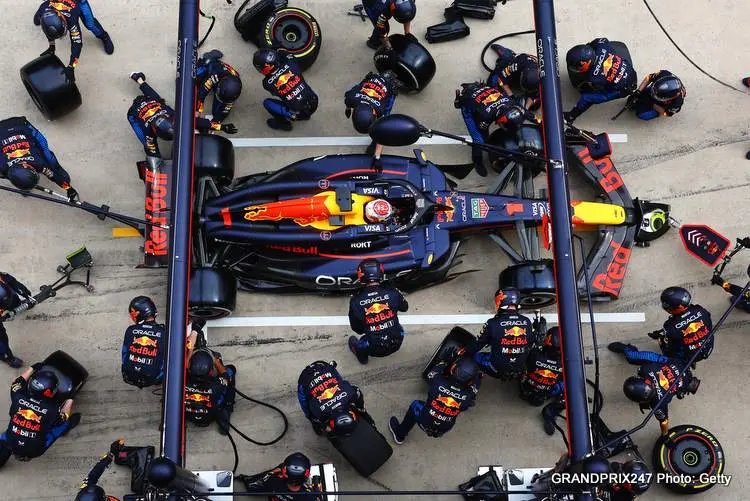
A typical crew comprises 20 people, each tasked with completing a specific role. Below are the categories:
- Tyre gunners: A team usually has four gunners, each working on a different wheel. Their role is to remove and fix wheel nuts to facilitate the changing of tyres, where necessary.
- Tyre carriers: The gunners do not carry or change the wheels. Instead, the carriers serve this role. Like with the gunners, there are four to ensure each wheel has a specific carrier to remove the old tyre and fit the new one.
- Jack operators: Tyre changes must be precise to keep up with the ticking clock. As such, a crew has two jack operators who lift the car, allowing the carriers and gunners to work together to fix the wheels. One operator is at the front and another at the back.
- Stabilizers: F1 cars move at high speeds. As such, by the time they come to a stop and prepare for wheel or other changes, instability may present. Stabilizers avoid such outcomes by ensuring the car is stable throughout the stop—they are often two, with one on each side of the car.
- Wing adjusters: Moving at high speeds requires cars to have modifications that enhance their aerodynamics. If the car needs adjustments, this role falls on the wing adjusters, who change the rear and back to match the current needs. Usually, teams have two adjusters, though some may have one.
- Lollipop man: Earlier, we mentioned that the lollipop man flags off the car after the pit stop, indicating that it has passed the checks. In addition to this role, they signal the driver when to stop. Teams usually have just one lollipop man.
- Fire extinguisher: Fire emergencies can happen, e.g., during a crash. Teams, therefore, designate one or two operators to serve this role. They are always on standby during pit stops to deal with any possible fires.
- Data analysts: As the car makes its way through the circuit, noting its performance can help the crew understand when they need to step in and why. Data analysts simplify this role by removing the guesswork and instead providing real-time stats that the team can use. The number of analysts often varies based on the size of the team.
With everyone handling a specific role, it's easy for the team to step in and fix problems as they arise without stalling the driver longer than is necessary.
Is It Always Rosy?
F1 pit crews work in highly dynamic environments. As such, they often grapple with the following challenges:
- The high stakes: A small mistake can result in a delay that can cost a driver a win. Even the standard 3-second stop is a long time for any driver, and teams often work with this pressure weighing on them.
- The safety issues: Pit stops occur on the circuits. As such, as teams work on the cars, they get exposed to other moving cars as well as the equipment they are using. They must take safety precautions while balancing the time requirements, which is not an easy task.
- The physical constraints: Whether working in pouring rain or the hot sun, the team must adhere to their timelines and ensure the weather does not affect their performance. Moreover, they must be fast and able to lug heavy equipment at all times.
Finally, the team must have excellent coordination and communication to avoid making errors. Their good results are a combination of their impeccable mental focus, real-time decision-making, and ability to handle stressful events while remaining calm. We can all learn something from these amazing teams!
Latest News



Loading