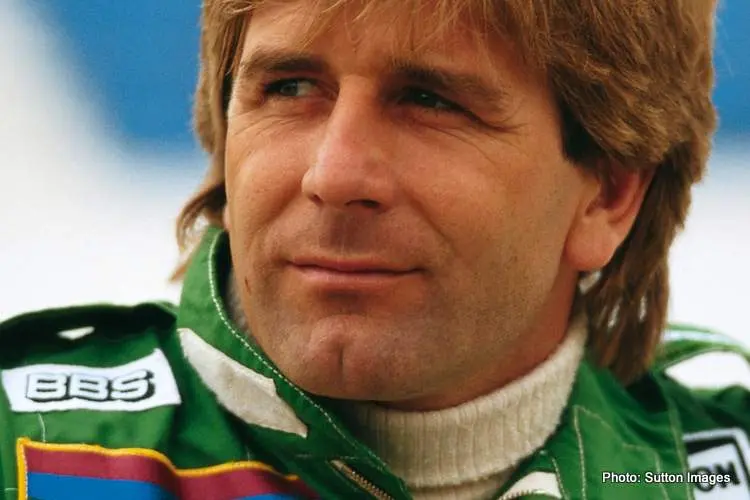
In a spate of less than a month in 1985, Germany lost two Formula 1 drivers, both killed in sports car events. Manfred Winkelhock died on 12 August at Mosport Park in Canada and Stefan Bellof in September at Spa-Francorchamps.
Winkelhock was born in Waiblingen, located next to Stuttgart. His early connection to cars came from his father who operated a garage.
In his early motorsports career, Winkelhock won the 1976 VW Scirocco Cup. He also struck a close friendship with Norbert Haug, long before the German journalist became head of Mercedes Motorsports department.
With support from Jochen Neerpasch’s BMW Junior programme, Winkelhock raced in Formula 2 from 1978 to 1981. In his first season, he finished eighth in the championship, his only podium in third came in the season finale at Hockenheimring.
In 1979, again there was only a single podium from yet another third-place finish, this time at the other ‘Ring - the Green Hell.
The 1980 season saw his third podium in as many years, and again from third step of the podium at Enna-Pergusa in Sicily. The most memorable moment from this season was his flight and flip over approaching Flugplatz.
A big and very scary accident
Repeat! This was a scary accident, and he was lucky to escape serious injuries. His fourth and final year in Formula 2 in 1981 produced two podium finishes, Hockenheim, where he was second in the Jim Clark Trophy behind Stefan Johansson and a third-place finish at Donington.
The Big Show

After a failed attempt to qualify for the 1980 Italian Grand Prix at Imola in Warsteiner Arrows, Winkelhock made his grand prix debut in the 1982 season opener at Kyalami, driving for the eccentric fellow German team owner Günther Schmidt and his ATS team. Winkelhock qualified 20th and finished 10th.
The next race was in Rio de Janeiro and his fifth-place finish was the only points he scored all season long. Seven DNFs from 13 races he started resulted in 22nd position in the standings amongst 26 drivers who scored points.
The 1983 season saw the ATS team powered by BMW engines. There were nine DNFs and his highest finish was outside the points in eighth in the penultimate race of the season, the European Grand Prix at Brands Hatch.
His third and final season in 1984 with ATS again resulted in a point-less campaign and nine DNFs. A pair of eighth place finishes, in Montreal and Dallas, was his best result. The final race of the season in Estoril, Portugal saw him at the wheel of a Brabham-BMW in tenth place.
The 1985 season turned out to be his final year in Formula 1, and as it turned out sadly, the last year of his life.
Winkelhock moved to the Skoal Bandit-sponsored RAM team with Brian Hart’s turbo engines. Again, there were far more DNFs than race finishes. He took the chequered flag in only two races, 13th in Brazil and 12th in France.
The Last Lap
[Author's Note: The use of the video below was deliberate, to highlight how motorsport has evolved and how many of our heroes die. If sensitive to this type of media, do not watch. Thank You.]
Winkelhock had dabbled in sports car racing before reaching Formula 1. In 1979, driving an Andy Warhol-painted BMW M1 Art Car, he, along with Hervé Poulain and Marcel Mignot, finished sixth overall at Le Mans, second in their class.
Teaming up with Swiss driver Marc Surer in a Kremer Porsche they won the 1985 Monza 1000km in late April. The race was stopped on Lap 138 of the scheduled 173, a fallen tree had blocked the track.
Round 6 of the World Sportscar Championship was on August 11 at Mosport Park. Winkelhock took over the car from Surer and going into the fast left-hander at Turn 2, Clayton Corner, the Porsche went off the track at high speed - reportedly due to a deflated tyre - and crashed into a concrete barrier. The front of the 962 was destroyed and it took almost 40 minutes to extricate the driver from the wreckage.
Winkelhock was flown to a Toronto hospital and underwent emergency surgery. His wife Martina was in Germany, Haug helped to arrange her flight to Canada. By the time she reached the hospital on Monday morning, all hope was gone. Later the same day Winkelhock's life support system was switched off.
The family’s racing legacy was continued successfully by his younger brother Joachim who won the 1993 British Touring Car Championship, and the 1999 Le Mans, both with BMW.
Winkelhock's son Markus was five years old at the time of the tragedy. In 2007, he made a fairy tale debut with Spyker in the European Grand Prix at the Nürburgring. And in 2011 became GT1 World Champion in a Mercedes.

Latest News
Loading