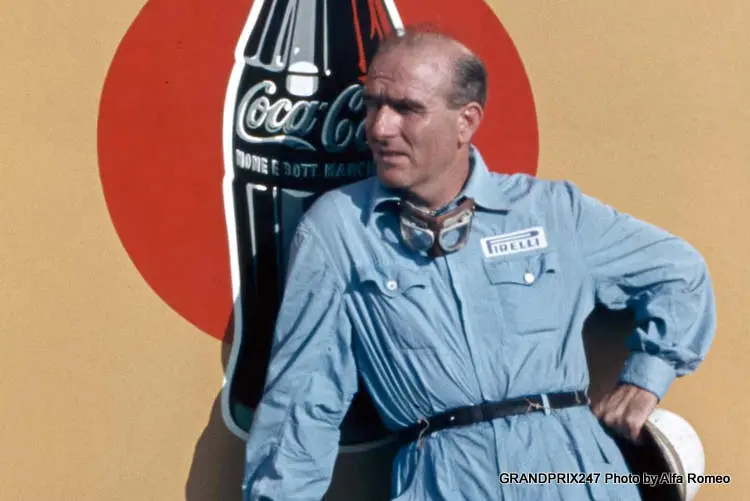
The name Pininfarina is synonymous with some of the most beautiful automotive designs, such as the Ferrari Daytona 365GTB/4, but Formula 1 aficionados know the name "Farina" as the winner of the first-ever FIA-sanctioned F1 World Championship Grand Prix at Silverstone in 1950.
For this historical achievement, Giuseppe “Nino” Farina was paid a handsome prize of £500.00! And the honour of being crowned the first Formula 1 world champion.
“Nino” Farina was born on 30 October 1906, in Turin. His uncle, Battista, was the founder of the legendary Pininfarina design firm. “Nino” graduated with a law degree and doctorate in Political Economy but was more interested in action on the track than in the courtroom.
Today’s arms-outstretched style of driving can be traced back to him. A young Stirling Moss had also copied the Italian. Farina’s early races were marred by crashes. His speed, determination and bravery caught the attention of the Alfa Romeo Racing team manager, Enzo Ferrari, who hired him as a teammate to the legendary “Flying Mantuan” Tazio Nuvolari.
Farina was runner-up three times at the wheel of an Alfa Romeo in the classic Mille Miglia, which ran on public roads from Brescia-Rome-Brescia, in 1936, ‘37 and ’40, the same year he also took victory in the Tripoli Grand Prix. After the war, Farina won the 1946 Grand Prix des Nations in Geneva for Alfa Romeo and took victory in the 1948 Monaco Grand Prix driving a Maserati.
Pole position. Fastest lap. World Champion.

The inaugural F1 championship season included six Grand Prix races and the Indianapolis 500. The European events were all won by the Alfa Romeo team. Farina won the season opener at Silverstone from pole position and set the fastest lap.
His Alfa Romeo teammate and main challenger for the championship, Juan Manuel Fangio, retired on lap 62 of 70. Missing in action was Scuderia Ferrari as Enzo decided not to enter cars over a prize-money dispute.
Round 2 was the Monaco Grand Prix. Alfa triumphed again from pole position, this time however, the winning driver was Fangio as Farina was caught up in the first lap melee which took out several cars.
Round three was across the pond at the Brickyard for the Indy 500, which was part of the world championship for the first decade of Formula 1. “The Greatest Spectacle in Racing” was skipped by all the Formula 1 teams”.
The Grand Prix circus gathered at the street circuit in Bremgarten for Round 4 of the championship, the Swiss Grand Prix. Farina took his second win of the season while Fangio once again failed to score any points, he retired on lap 33 of 42 after starting from pole position.
The first great F1 rivalry: Farina versus Fangio

Farina led the championship at this stage with 18 points, followed by Fagioli on 12 points and Fangio was joint third on nine points with Johnny Parsons, who earned his points from winning the Indy 500. Fangio took back-to-back victories in Belgium and France.
At Spa, there were three Alfa Romeos in the top four. Fagioli was second ahead of French driver Louis Rosier in a Talbot-Lago. Farina started from pole position and finished fourth.
In the French Grand Prix at Reims Fangio took victory from pole position ahead of Fagioli. Farina’s failure to score any points, he retired on lap 55 of 64, set up a grand finale at Monza to crown Formula 1’s first world champion. Fangio had the advantage; he was leading the championship with 26 points. Fagioli was second on 24 points and Farina was third with 22 points.
The Argentine “Maestro” took pole position but lost the lead to Farina at the start. Later in his memoirs, Fangio would claim about the Alfa Romeo team stating, “His (Farina’s) Alfa 158 had been equipped with increased power by the factory’s technicians”.
Nino Farina the first F1 World Champion

In the 80-lap race, Fangio was running third when gearbox gremlins forced him into the pits on Lap 24. As per regulations of the day he took over the car of Piero Taruffi. Two laps later Fangio was second behind his championship challenger. On Lap 34, the dream was over for the “Maestro” as he suffered engine issues. Farina went on to win his home grand prix.
A three-point advantage entered Farina’s name in the history books as the first Formula 1 World Champion.
In 1951, Farina finished on the podium in four of the five races he finished. The only victory of the season came at Spa. He finished the season fourth in the championship which saw his Alfa teammate Fangio take the first of his five championships.
For the 1952 season, Farina moved to Maranello. He did not win any races but four second-place finishes helped him to second in the championship to Ferrari teammate Alberto Ascari. Taruffi gave Italy top three drivers in the standings.
In the 1953 season, Farina took one victory at the Nürburgring and was on the podium in five of the six races he finished. He was third in the championship behind Maserati driver Fangio, and his own Ferrari teammate Ascari, the Milanese took five wins to become Formula 1’s first double-world champion.
The same year Farina and Piero Scotti won the 12 Hours of Casablanca in a Ferrari 375 MM ahead of Luigi Villoresi and Ascari.
The Last Lap

The fearless Farina was incredibly lucky in his racing career. He was known for his aggressive driving style and survived numerous accidents. In the August 2003 edition of Motorsport magazine, the great Stirling Moss told journalist Nigel Roebuck.
“Farina was a great driver, but everyone was wary of him because he was dangerous — he had an absolute disregard for anyone else on the track, even inexperienced drivers he was lapping. And if you got involved in a dice with him, he was completely ruthless; he’d do things that would never even cross the mind of a man like Fangio.”
Sadly, such ruthlessness cost the lives of two of his rivals. In the 1936 Deauville Grand Prix, Farina’s Scuderia Ferrari entered Alfa Romeo collided with the ERA of Marcel Lehoux resulting in fatal injuries for the French driver.
Two years later, on Lap 12 of the 1938 Tripoli Grand Prix at the Mellaha circuit, a similar accident cost the life of Hungarian driver Laszlo Hartmann. This was the second fatality of the race, three laps earlier Italian driver Eugenio Siena lost control of his Alfa, went off the track and crashed into a small house by the track. The race was won by Mercedes driver Hermann Lang.
On June 30, 1966, Farina ran out of luck. The life of Formula 1’s first world champion came to an end while he was on his way to the French Grand Prix. He lost control of his Lotus-Cortina over a patch of ice near Chambery. The car hit a telegraph pole, killing him. He was 59 years old.
Latest News
Loading

